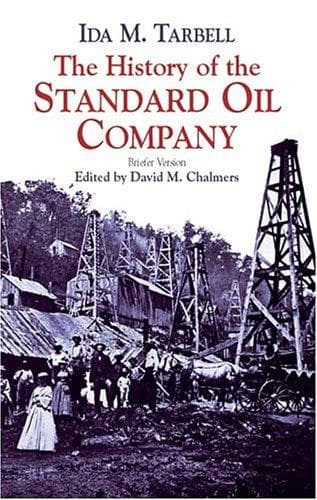
The History of the Standard Oil CompanyTarbell, Ida M. (Ida Minerva)
History
The History of the Standard Oil Company
Tarbell, Ida M. (Ida Minerva)
Petroleum industry and trade -- United States -- History; Standard Oil Company -- History
Here we have a refiner discouraged by the conditions which Mr.
Rockefeller claims his aggregation will cure. Under the Rutter circular
and the discrimination in freight to the Standard which followed, his
difficulty in getting oil increases, and he consents to a running
arrangement with Mr. Rockefeller’s partner in Philadelphia, but he wants
to do an “independent business.” Impossible. As he sits watching the
smooth and terrible power of that famous Corliss engine of 1876, an
engine which showed to thousands for the first time what great power
properly directed means, he realised that something very like it was at
work in the oil business—something resistless, silent, perfect in its
might—and he sold out to that something. Everywhere men did the same.
The history of oil refining on Oil Creek from 1875 to 1879 is almost
uncanny. There were at the beginning of that period twenty-seven plants
in the region, most of which were in a fair condition, considering the
difficulties in the business. During 1873 the demand for refined oil had
greatly increased, the exports nearly doubling over those of 1872. The
average profit on refined that year in a well-managed refinery was not
less than three cents a gallon. During the first half of 1874 the oil
business had been depressed, but the oil refiners were looking for
better times when the Rutter circular completely demoralised them by
putting fifty cents extra freight charges on their shipments without an
equivalent raise on competitive points. It was not only this extra
charge, enough to cut off their profits, as business then stood, but it
was that the same set of men who had thrown their business into
confusion in 1872 was again at work. The announcement of the Central
Association with Mr. Rockefeller’s name at its head confirmed their
fears. Nevertheless at first none of the small refiners would listen to
the proposition to sell or lease made them in the spring of 1875 by the
representative first sent out by the Central Association. They would
have nothing to do, they said bluntly, with any combination engineered
by John D. Rockefeller. The representative withdrew and the case was
considered. In the mean time conditions on the creek grew harder. All
sorts of difficulties began to be strewn in their way—cars were hard to
get, the markets they had built up were cut under them—a demoralising
conviction was abroad in the trade that this new and mysterious
combination was going to succeed; that it was doing rapidly what its
members were reported to be saying daily: “We mean to secure the entire
refining business of the world.” Such was the state of things on the
creek when in the early fall of 1875 an energetic young refiner and oil
buyer well known in the Oil Regions, J. D. Archbold, appeared in
Titusville as the representative of a new company, the Acme Oil Company,
a concern which everybody believed to be an offshoot of the Standard Oil
Company of Cleveland, though nobody could prove it.
Public-domain text, read in full here on John Shaqi.
Reviews
Reviews
No reviews yet
Be the first to share your thoughts on this work.
Elsewhere in the archive
Join the Discussion
Join the discussion
Sign in to leave a comment or review.
Sign InorCreate an account