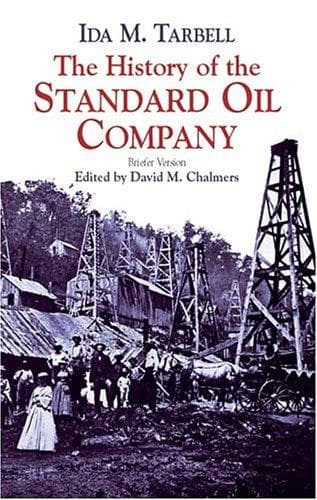
The History of the Standard Oil CompanyTarbell, Ida M. (Ida Minerva)
History
The History of the Standard Oil Company
Tarbell, Ida M. (Ida Minerva)
Petroleum industry and trade -- United States -- History; Standard Oil Company -- History
As a matter of fact
the Acme was capitalised and controlled entirely by Standard men, its
stockholders being, in addition to Mr. Archbold, William Rockefeller,
William G. Warden, Frank Q. Barstow, and Charles Pratt. It was evident
at once that the Acme Oil Company had come into the Oil Regions for the
purpose of absorbing the independent interests as Mr. Rockefeller and
his colleagues were absorbing them elsewhere. The work was done with a
promptness and despatch which do great credit to the energy and
resourcefulness of the engineer of the enterprise. In three years, by
1878, all but two of the refineries of Titusville had “retired from the
business gloriously,” as Mr. Archbold, flushed with victory, told the
counsel of the Commonwealth of Pennsylvania in 1879, when the state
authorities were trying to find what was at work in the oil interests to
cause such a general collapse. Most of the concerns were bought
outright, the owners being convinced that it was impossible for them to
do an independent business, and being unwilling to try combination. All
down the creek the little refineries which for years had faced every
difficulty with stout hearts collapsed. “Sold out,” “dismantled,” “shut
down,” is the melancholy record of the industry during these four years.
At the end practically nothing was left in the Oil Regions but the Acme
of Titusville and the Imperial of Oil City, both of them now under
Standard management. To the oil men this sudden wiping out of the score
of plants with which they had been familiar for years seemed a crime
which nothing could justify. Their bitterness of heart was only
intensified by the sight of the idle refiners thrown out of business by
the sale of their factories. These men had, many of them, handsome sums
to invest, but what were they to put them in? They were refiners, and
they carried a pledge in their pockets not to go into that business for
a period of ten years. Some of them tried the discouraged oil man’s
fatal resource, the market, and as a rule left their money there. One
refiner who had, according to popular report, received $200,000 for his
business, speculated the entire sum away in less than a year. Others
tried new enterprises, but men of forty learn new trades with
difficulty, and failure followed many of them. The scars left in the Oil
Regions by the Standard Combination of 1875–1879 are too deep and ugly
for men and women of this generation to forget them.
Public-domain text, read in full here on John Shaqi.
Reviews
Reviews
No reviews yet
Be the first to share your thoughts on this work.
Elsewhere in the archive
Join the Discussion
Join the discussion
Sign in to leave a comment or review.
Sign InorCreate an account