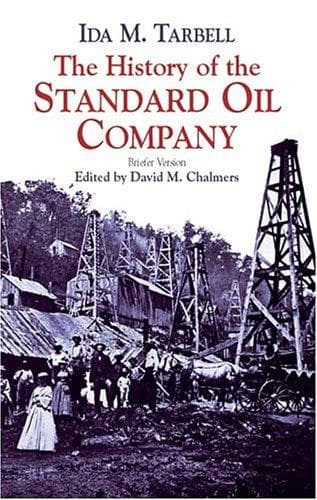
The History of the Standard Oil CompanyTarbell, Ida M. (Ida Minerva)
History
The History of the Standard Oil Company
Tarbell, Ida M. (Ida Minerva)
Petroleum industry and trade -- United States -- History; Standard Oil Company -- History
In Pittsburg the same thing was happening. At the beginning of the work
of absorption—1874—there were between twenty-two and thirty refineries
in the town.[51] As we have seen, Lockhart and Frew sold to the Standard
Oil Company of Cleveland some time in 1874. In the fall of that year a
new company was formed in Pittsburg, called the Standard Oil Company of
Pittsburg. Its president was Charles Lockhart; its directors William
Frew, David Bushnell, H. M. Flagler, and W. G. Warden—all members of the
Standard Oil Company and four of them stockholders in the South
Improvement Company. This company at once began to lease or buy
refineries. Many of the Pittsburg refiners made a valiant fight to get
rates on their oil which would enable them to run independently. To save
expense they tried to bring oil from the oil fields by barge; the
pipe-lines in the pool refused to run oil to barges, the railroad to
accept oil brought down by barge. An independent pipe-line attempted to
bring it to Pittsburg, but to reach the works the pipe-line must run
under a branch of the Pennsylvania railroad. It refused to permit this,
and for months the oil from the line was hauled in wagons from the point
where it had been held up, over the railroad track, and there repiped
and carried to Pittsburg. At every point they met interference until
finally one by one they gave in. According to Mr. Frew, who in 1879 was
examined as to the condition of things in Pittsburg, the company began
to “acquire refiners” in 1875. In 1877 they bought their last one; and
at the time Mr. Frew was under examination he could not remember but
_one_ refinery in operation in Pittsburg not controlled by his company.
Nor was it refiners only who sold out. All departments of the trade
began to yield to the pressure. There was in the oil business a class of
men known as shippers. They bought crude oil, sent it East, and sold it
to refineries there. Among the largest of these was Adnah Neyhart, whose
active representative was W. T. Scheide. Now to Mr. Rockefeller the
independent shipper was an incubus; he did a business which, in his
judgment, a firm ought to do for itself, and reaped a profit which might
go direct into the business. Besides, so long as there were shippers to
supply crude to the Eastern refineries at living prices, so long these
concerns might resist offers to sell or lease.
Public-domain text, read in full here on John Shaqi.
Reviews
Reviews
No reviews yet
Be the first to share your thoughts on this work.
Elsewhere in the archive
Join the Discussion
Join the discussion
Sign in to leave a comment or review.
Sign InorCreate an account