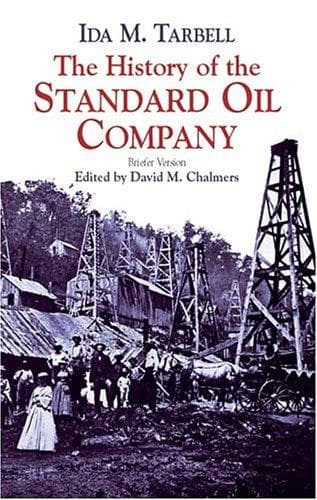
The History of the Standard Oil CompanyTarbell, Ida M. (Ida Minerva)
History
The History of the Standard Oil Company
Tarbell, Ida M. (Ida Minerva)
Petroleum industry and trade -- United States -- History; Standard Oil Company -- History
Of course securing a large crude shipping business like Mr. Neyhart’s
was a valuable point for the Standard. It threw all of the refiners whom
he had supplied out of crude oil and forced several of them to come to
the Standard buyer—a first step, of course, toward a lease or sale. At
every point, indeed, making it difficult for the refiner to get his raw
product was one of the favourite manœuvres of the combination. It was
not only to crude oil it was applied. Factories which worked up the
residuum or tar into lubricating oil and depended on Standard plants for
their supply were cut off. There was one such in Cleveland—the firm of
Morehouse and Freeman. Mr. Morehouse had begun to experiment with
lubricating oils in 1861, and in 1871 the report of the Cleveland Board
of Trade devoted several of its pages to a description of his business.
According to this account he was then making oils adapted to lubricating
all kinds of machinery—he held patents for several brands and trade
marks, and had produced that year over 25,000 barrels of different
lubricants besides 120,000 boxes of axle grease. At this time he was
buying his stock or residuum from one or another of the twenty-five
Cleveland refiners. Then came the South Improvement Company and the
concentration of the town’s refining interest in Mr. Rockefeller’s
hands. Mr. Morehouse, according to the testimony he gave the Hepburn
Commission in 1879, went to Mr. Rockefeller, after the consolidation, to
arrange for supplies. He was welcomed—the Standard Oil Company had not
at that time begun to deal in lubricating oils—and encouraged to build a
new plant. This was done at a cost of $41,000, and a contract was made
with the Standard Oil Company for a daily supply of eighty-five barrels
of residuum. Some time in 1874 this supply was cut down to twelve
barrels. The price was put up too, and contracts for several months were
demanded so that Mr. Morehouse got no advantage from the variation in
crude prices. Then the freights went up on the railroads. He paid $1.50
and two dollars for what he says he felt sure his big neighbour was
paying but seventy or seventy-five cents (there is no evidence of any
such low rate to the Standard from Cleveland to New York by rail). Now
it was impossible for Mr. Morehouse to supply his trade on twelve
barrels of stock. He begged Mr. Rockefeller for more. It was there in
the Standard Oil works. Why could he not have it? He could pay for it.
He and his partner offered to buy 5,000 barrels and store it, but Mr.
Rockefeller was firm. All he could give Mr. Morehouse was twelve barrels
a day. “I saw readily what that meant,” said Mr. Morehouse, “that meant
squeeze you out—buy your works. They have got the works and are running
them; I am without anything. They paid about $15,000 for what cost me
$41,000. He said that he had facilities for freighting and that the
coal-oil business belonged to them; and any concern that would start in
Public-domain text, read in full here on John Shaqi.
Reviews
Reviews
No reviews yet
Be the first to share your thoughts on this work.
Elsewhere in the archive
Join the Discussion
Join the discussion
Sign in to leave a comment or review.
Sign InorCreate an account