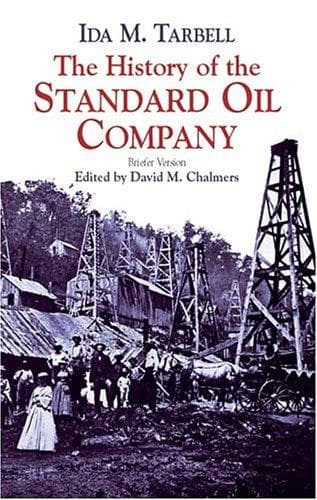
The History of the Standard Oil CompanyTarbell, Ida M. (Ida Minerva)
History
The History of the Standard Oil Company
Tarbell, Ida M. (Ida Minerva)
Petroleum industry and trade -- United States -- History; Standard Oil Company -- History
that business, they had sufficient money to lay aside a fund to wipe
them out—these are the words.”[52]
At every refining centre in the country this process of consolidation
through persuasion, intimidation, or force, went on. As fast as a
refinery was brought in line its work was assigned to it. If it was an
old and poorly equipped plant it was usually dismantled or shut down. If
it was badly placed, that is, if it was not economically placed in
regard to a pipe-line and railroad, it was dismantled even though in
excellent condition. If it was a large and well-equipped plant
advantageously located it was assigned a certain quota to manufacture,
and it did nothing but manufacture. The buying of crude, the making of
freight rates, the selling of the output remained with Mr. Rockefeller.
The contracts under which all the refineries brought into line were run
were of the most detailed and rigid description, and they were executed
as a rule with a secrecy which baffles description. Take, for example, a
running arrangement made by Rockefeller in 1876, with a Cleveland
refinery, that of Scofield, Shurmer and Teagle. The members of this
concern had all been in the refining business in Cleveland in 1872 and
had all handed over their works to Mr. Rockefeller, when he notified
them of the South Improvement Company’s contracts. Mr. Shurmer declared
once in an affidavit that he alone lost $20,000 by that manœuvre. The
members of the firm had not stayed out of business, however. Recovering
from the panic caused by the South Improvement Company, they had united
in 1875, building a refinery worth $65,000, with a yearly capacity of
180,000 barrels of crude. On the first year’s business they made
$40,000. Although this was doing well, they were convinced they might do
better if they could get as good freight rates as the Standard Oil
Company, and in the spring of 1876 they brought suit against the Lake
Shore and Michigan Southern and the New York Central and Hudson River
Railroads for “unlawful and unjust discrimination, partialities and
preferences made and practised ... in favour of the Standard Oil
Company, enabling the said Standard Oil Company to obtain to a great
extent the monopoly of the oil and naphtha trade of Cleveland.” The suit
was not carried through at the time. Mr. Rockefeller seems to have
suggested a surer way to the firm of getting the rates they wanted. This
was to make a running arrangement with him. He seems to have
demonstrated to them that they could make more money under his plan than
outside, and they signed a contract for a remarkable “joint adventure.”
According to this document Scofield, Shurmer and Teagle put into the
business a plant worth at that time about $73,000 and their entire time.
Mr. Rockefeller put in $10,000 and his rebates! That is, he secured for
the firm the same preferential rates on their shipments that the
Standard Oil Company enjoyed. The firm bound itself not to refine over
Public-domain text, read in full here on John Shaqi.
Reviews
Reviews
No reviews yet
Be the first to share your thoughts on this work.
Elsewhere in the archive
Join the Discussion
Join the discussion
Sign in to leave a comment or review.
Sign InorCreate an account