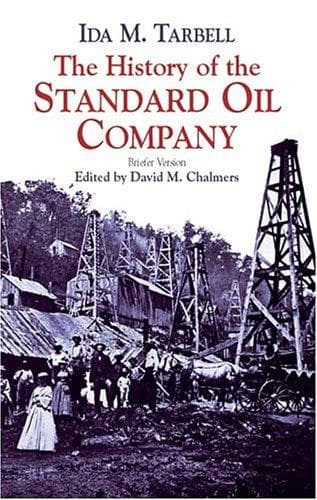
The History of the Standard Oil CompanyTarbell, Ida M. (Ida Minerva)
History
The History of the Standard Oil Company
Tarbell, Ida M. (Ida Minerva)
Petroleum industry and trade -- United States -- History; Standard Oil Company -- History
From the time the Central Association announced itself, independent
refiners and the producers as a body watched developments with
suspicion. They had little to go on. They had no means of proving what
was actually the fact that the Central Association was the Standard Oil
Company working secretly to bring its competitors under control or drive
them out of business. They had no way of knowing what was actually the
fact that the Standard had contracts with the Central, Erie and the
Pennsylvania which gave them rebates on the lowest tariff which others
paid. That this must be the case, however, they were convinced, and they
determined early in 1876 to call on Congress for another investigation.
A hearing was practically insured, for Congress since 1872 had given
serious attention to the transportation troubles. The Windom Committee
of 1874 had made a report, the sweeping recommendations of which gave
much encouragement to those who suffered from the practices of the
railroads. Among other things this committee recommended that all rates,
drawbacks, etc., be published at every point and no changes allowed in
them without proper notification. It recommended the Bureau of Commerce
which, in 1902, twenty-eight years later, was created. So serious did
the Windom Committee consider the situation in 1874, that it made the
following radical recommendations:
The only means of securing and maintaining reliable and effective
competition between railways is through national or state ownership,
or control of one or more lines which, being unable to enter into
combinations, will serve as a regulation of other lines.
One or more double-track freight-railways honestly and thoroughly
constructed, owned or controlled by the government, and operated at
a low rate of speed, would doubtless be able to carry at a much less
cost than can be done under the present system of operating fast and
slow trains on the same road; and, being incapable of entering into
combinations, would no doubt serve as a very valuable regulator of
existing railroads within the range of their influence.
Public-domain text, read in full here on John Shaqi.
Reviews
Reviews
No reviews yet
Be the first to share your thoughts on this work.
Elsewhere in the archive
Join the Discussion
Join the discussion
Sign in to leave a comment or review.
Sign InorCreate an account