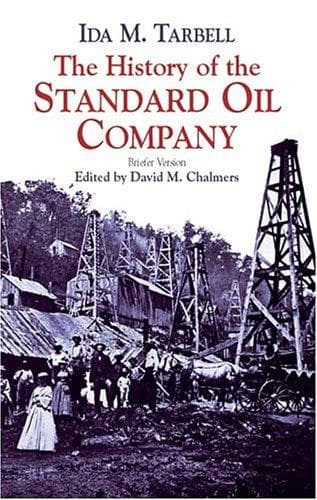
The History of the Standard Oil CompanyTarbell, Ida M. (Ida Minerva)
History
The History of the Standard Oil Company
Tarbell, Ida M. (Ida Minerva)
Petroleum industry and trade -- United States -- History; Standard Oil Company -- History
With Congress in such a temper the oil men felt that there might be some
hope of securing the regulation of interstate commerce they had asked
for in 1872. The agitation resulted in the presentation in the House of
Representatives, in April, of the first Interstate Commerce Bill which
promised to be effective. The bill was presented by James H. Hopkins of
Pittsburg. Mr. Hopkins had before his eyes the uncanny fate of the
independent oil interests of Pittsburg, some twenty-five factories in
that town having been reduced to two or three in three and one-half
years. He had seen the oil-refining business of the state steadily
reduced, and he thought it high time that something was done. In aid of
his bill a House investigation was asked. It was soon evident that the
Standard was an enemy of this investigation. Through the efforts of a
good friend of the organisation—Congressman H. B. Payne, of
Cleveland—the matter was referred to the Committee on Commerce, where a
member of the house, J. N. Camden, whose refinery, the Camden
Consolidated Oil Company, if it had not already gone, soon after went
into the Standard Oil Alliance, appeared as adviser of the chairman! Now
what Mr. Hopkins wanted was to compel the railroads to present their
contracts with the Standard Oil Company. The Committee summoned the
proper railroad officers, Messrs. Cassatt, Devereux and Rutter, and O.
H. Payne, treasurer of the Standard Oil Company. Of the railroad men,
only Mr. Cassatt appeared, and he refused to answer the questions asked
or to furnish the documents demanded. Mr. Payne refused also to furnish
the committee with information. The two principal witnesses of the oil
men were E. G. Patterson of Titusville, to whose energy the
investigation was largely due, and Frank Rockefeller of Cleveland, a
brother of John D. Rockefeller. Mr. Patterson sketched the history of
the oil business since the South Improvement Company identified the
Standard Oil Company with that organisation, and framed the specific
complaint of the oil men, as follows: “The railroad companies have
combined with an organisation of individuals known as the Standard Ring;
they give to that party the sole and entire control of all the petroleum
refining interest and petroleum shipping interest in the United States,
and consequently place the whole producing interest entirely at their
mercy. If they succeed they place the price of refined oil as high as
they please. It is simply optional with them how much to give us for
what we produce.”
Public-domain text, read in full here on John Shaqi.
Reviews
Reviews
No reviews yet
Be the first to share your thoughts on this work.
Elsewhere in the archive
Join the Discussion
Join the discussion
Sign in to leave a comment or review.
Sign InorCreate an account