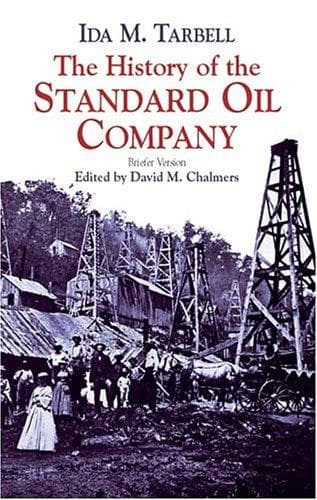
The History of the Standard Oil CompanyTarbell, Ida M. (Ida Minerva)
History
The History of the Standard Oil Company
Tarbell, Ida M. (Ida Minerva)
Petroleum industry and trade -- United States -- History; Standard Oil Company -- History
Some time in April, 1876, the most ambitious project of all was
announced. This was a seaboard pipe-line to be run from the Oil Regions
to Baltimore. Up to this time the pipe-lines had been used merely to
gather the oil from the wells and carry it to the railroads. The longest
single line in operation was the Columbia Conduit, and it was built
thirty miles long. The idea of pumping oil over the mountains to the sea
was regarded generally as chimerical. To a trained civil engineer it did
not, however, present any insuperable obstacles, and in the winter of
1875 and 1876 Henry Harley, whose connection with the Pennsylvania
Transportation Company has already been noted, went to his old chief in
the Hoosac Tunnel, General Herman Haupt, and laid the scheme before him.
If it was a feasible idea would General Haupt take charge of the
engineering for the Pennsylvania Transportation Company? At the same
time Mr. Harley employed General Benjamin Butler to look after the legal
side of such an undertaking. Both General Haupt and General Butler were
enthusiastic over the idea and took hold of the work with a will. It was
not long before the scheme began to attract serious attention. The
Eastern papers in particular took it up. The references to it were, as a
whole, favourable. It was regarded everywhere as a remarkable
undertaking: “Worthy,” the New York Graphic said, “to be coupled with
the Brooklyn Bridge, the blowing up of Hell Gate, and the tunnelling of
the Hudson River.” As General Haupt’s plans show, it was a tremendous
undertaking, for the line would be, when finished, at least 500 miles
long, and it would be worked by thirty or more tremendous pumps. On July
25 a meeting was held at Parker’s Landing, presenting publicly the
reports of General Haupt and General Butler. The authority and
seriousness of the scheme as set forth at this meeting alarmed the
railroads. If this seaboard line went through it was farewell to the
railroad-Standard combination. Oil could be shipped to the seaboard by
it at a cost of 16⅔ cents a barrel, General Haupt estimated. All of the
interests, little and big, which believed that they would be injured by
the success of the line, began an attack.
Curiously enough one of the first points of hostility was General Haupt
himself. An effort was made to discredit his estimate in order to scare
people from taking stock. They recalled the Hoosac Tunnel scandal and
the fact that the General once built a bridge which had tumbled down,
ridiculed his estimate of the cost, etc., etc. The “card” in which
General Haupt answered his chief critic, one who signed himself “Vidi,”
was admirable:
A CARD FROM GENERAL HAUPT
What are the charges that I am requested to “smash”?
They are, as I understand them from others, for some I have not
seen:
1. That I once built a bridge that tumbled down.
2. That I was connected with the Hoosac Tunnel that cost seventeen
millions of dollars.
Public-domain text, read in full here on John Shaqi.
Reviews
Reviews
No reviews yet
Be the first to share your thoughts on this work.
Elsewhere in the archive
Join the Discussion
Join the discussion
Sign in to leave a comment or review.
Sign InorCreate an account