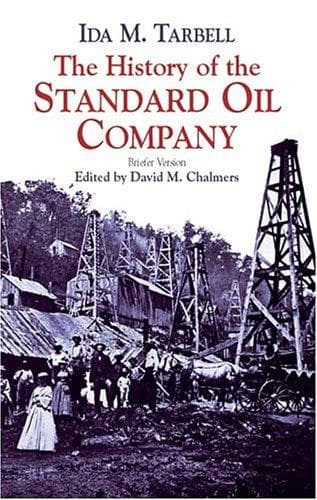
The History of the Standard Oil CompanyTarbell, Ida M. (Ida Minerva)
History
The History of the Standard Oil Company
Tarbell, Ida M. (Ida Minerva)
Petroleum industry and trade -- United States -- History; Standard Oil Company -- History
He put down his pipes, and the railroad sent a force of
armed men to the spot, tore up the pipes, fortified their position and
prepared to hold the fort. The oil men came down in a body, and, seizing
an opportune moment, got possession of the disputed point. The railroad
had thirty of them arrested for riot, but was not able to get them
committed; it did succeed, however, in preventing the relaying of the
pipes and a long litigation over Dr. Hostetter’s right to pass under the
road ensued. Disgusted with this turn of affairs Dr. Hostetter leased
the line to three young independent oil men of whom we are to hear more
later. They were B. D. Benson, David McKelvy and Major Robert E.
Hopkins, all of Titusville. Resourceful and determined they built tank
wagons into which the oil from the pipe was run and was carted across
the tracks on the public highway, turned into storage tanks and again
repiped and pumped to Pittsburg. They were soon doing a good business.
The fight to get the Columbia Conduit Line into Pittsburg aroused again
the agitation in favour of a free pipe-line bill, and early in 1875
bills were presented in both the Senate and House of the state and
bitter and long fights over them followed. It was charged that the bills
were in the interest of Dr. Hostetter. He wants to transport his blood
bitters cheaply, sneered one opponent! Many petitions for the bill were
circulated, but there were even stronger remonstrances and the source of
some of them was suspicious enough; for instance, that of the “Pittsburg
refiners representing about one-third of the refining capacity of the
Pennsylvania district and nearly one-third of the entire capacity now in
business.” As the Pittsburg refiners were nearly all either owned or
leased by the Standard concern, and the few independents had no hope
save in a free pipe-line, there seems to be no doubt about the origin of
that remonstrance. Although the bills were strongly supported, they were
defeated, and the Columbia Conduit Line continued to “break bulk” and
cart its oil over the railroad track.
Another route was arranged which for a time promised success. This was
to bring crude oil by barges to Pittsburg, then to carry the refined
down the Ohio River to Huntington and thence by the Richmond and
Chesapeake road to Richmond. This scheme, started in February, was well
under way by May, and “On to Richmond!” was the cry of the independents.
Everything possible was done to make this attempt fail. An effort was
even made to prevent the barges which came down the Allegheny River from
unloading, and this actually succeeded for some time. There seemed to be
always some hitch in each one of the channels which the independents
tried, some point at which they could be so harassed that the chance of
a living freight rate which they had seen was destroyed.
Public-domain text, read in full here on John Shaqi.
Reviews
Reviews
No reviews yet
Be the first to share your thoughts on this work.
Elsewhere in the archive
Join the Discussion
Join the discussion
Sign in to leave a comment or review.
Sign InorCreate an account