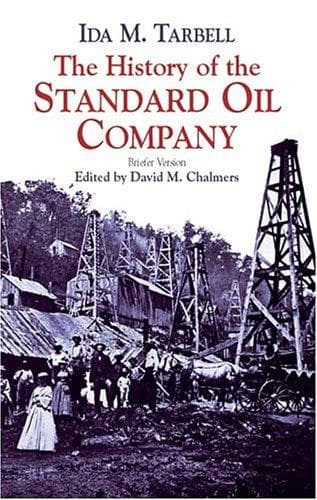
The History of the Standard Oil CompanyTarbell, Ida M. (Ida Minerva)
History
The History of the Standard Oil Company
Tarbell, Ida M. (Ida Minerva)
Petroleum industry and trade -- United States -- History; Standard Oil Company -- History
I have put coal at five dollars per ton or eighteen cents per
bushel, now worth five cents at Brady’s and eight at Pittsburg. Is
not this enough? I have allowed fifty per cent. greater consumption
at each station than has been estimated by others. I have allowed
$1,000 a year for each of two engine men at each station. Will
anyone say this is not sufficient? And I have, to be safe, estimated
the work down below the results given by any of the ordinary
hydraulic formula. It would be absurd to tell experienced pipe men
that oil cannot be pumped fifteen miles under 900 pounds pressure
through a four–inch pipe with a discharge of 5,000 barrels per day,
which is all that the estimate is based upon, and it allows
sixty-five days’ stoppage besides.
Please, gentlemen, let me alone. I have had enough of newspaper
controversy in former years. I am sick of it.
H. HAUPT.
At the same time that General Haupt was attacked the Pennsylvania
Transportation Company was criticised for bad management. A long letter
to the Derrick August 14, 1876, claimed that the company in the past had
been mismanaged; that the credit it asked could not be given safely;
that its management had been such that it had scarcely any business
left. Indeed this critic claimed that the last pipe-line organised, a
small line known as the Keystone, had during the last six months done
almost double the business of the Pennsylvania. Under the direction of
the Pennsylvania Railroad, it was believed, the Philadelphia papers
began to attack the plan. Their claim was that the charters under which
the Pennsylvania Transportation Company expected to operate would not
allow them to lay such a pipe-line. The opposition became such that the
New York papers began to take notice of it. The Derrick on September 16,
1876, copies an article from the New York Bulletin in which it is said
that the railroads and the Standard Oil Company, “now stand in
gladiatorial array, with shields poised and sword ready to deal the
cut.” An opposition began to arise, too, from farmers through whose
property an attempt was being made to obtain right of way. In Indiana
and Armstrong counties the farmers complained to the secretary of
internal affairs, saying that the company had no business to take their
property for a pipe-line. One of the common complaints of the farmers’
newspapers was that leakage from the pipes would spoil the springs of
water, curdle milk, and burn down barns. The matter assumed such
proportions that the secretary referred it to the attorney-general for a
hearing. In the meantime the Pennsylvania Transportation Company made
the most strenuous efforts to secure the right of way. A large number of
men were sent out to talk over the farmers into signing the leases. Hand
bills were distributed with an appeal to be generous and to free the oil
business from a monopoly that was crushing it. These same circulars told
Public-domain text, read in full here on John Shaqi.
Reviews
Reviews
No reviews yet
Be the first to share your thoughts on this work.
Elsewhere in the archive
Join the Discussion
Join the discussion
Sign in to leave a comment or review.
Sign InorCreate an account