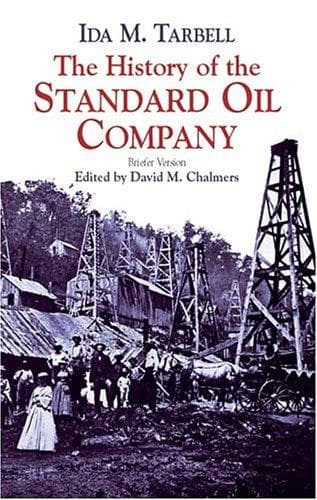
The History of the Standard Oil CompanyTarbell, Ida M. (Ida Minerva)
History
The History of the Standard Oil Company
Tarbell, Ida M. (Ida Minerva)
Petroleum industry and trade -- United States -- History; Standard Oil Company -- History
the farmers that a monopoly had hired agents all along the route
misrepresenting the facts about their intentions. Mr. Harley, under the
excitement of the enterprise and the opposition it aroused, became a
public figure, and in October the New York Graphic gave a long interview
with him. In this interview Mr. Harley claimed that the pipe-line scheme
was gotten up to escape the Standard Oil monopoly. Litigation, he
declared, was all his scheme had to fear. “John D. Rockefeller,
president of the Standard monopoly,” he said, “is working against us in
the country newspapers, prejudicing the farmers and raising issues in
the courts, and seeking also to embroil us with other carrying lines.”
It was not long, however, before something more serious than the farmers
and their complaints got in the way of the Pennsylvania Transportation
Company. This was a rumour that the company was financially embarrassed.
Their certificates were refused on the market, and in November a
receiver was appointed. Different members of the company were arrested
for fraud, among them two or three of the best known men in the Oil
Regions. The rumours proved only too true. The company had been grossly
mismanaged, and the verification of the charges against it put an end to
this first scheme for a seaboard pipe-line.
While all these efforts doomed to failure or to but temporary success
were making, a larger attempt to meet Mr. Rockefeller’s consolidation
was quietly under way. Among those interested in the oil business who
had watched the growing power of the Standard with most concern was the
head of the Empire Transportation Company, Colonel Joseph D. Potts. In
connection with the Pennsylvania Railroad Colonel Potts had built up
this concern, founded in 1865, until it was the most perfectly developed
oil transporter in the country. It operated 500 miles of pipe, owned a
thousand oil-tank cars, controlled large oil yards at Communipaw, New
Jersey, was in every respect indeed a model business organisation, and
it had the satisfaction of knowing that what it was it had made itself
from raw material, that its methods were its own, and that the practices
it had developed were those followed by other pipe-line companies. While
the Empire had far outstripped all its early competitors, there had
grown up in the last year a rival concern which Colonel Potts must have
watched with anxiety. This concern, known as the United Pipe Line, was
really a Standard organisation, for Mr. Rockefeller, in carrying out his
plan of controlling all the oil refineries of the country, had been
forced gradually into the pipe-line business.
Public-domain text, read in full here on John Shaqi.
Reviews
Reviews
No reviews yet
Be the first to share your thoughts on this work.
Elsewhere in the archive
Join the Discussion
Join the discussion
Sign in to leave a comment or review.
Sign InorCreate an account