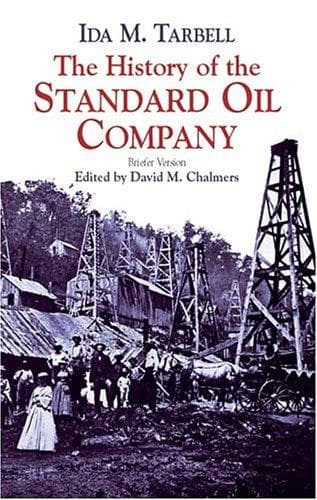
The History of the Standard Oil CompanyTarbell, Ida M. (Ida Minerva)
History
The History of the Standard Oil Company
Tarbell, Ida M. (Ida Minerva)
Petroleum industry and trade -- United States -- History; Standard Oil Company -- History
The American Transfer Company was soon working in harmony with the
United Pipe Lines, of which Captain J. J. Vandergrift was the president.
This system had its nucleus, like all the others of the country, in a
short private line, built in 1869 by Captain Vandergrift. It had grown
until in 1874 it handled thirty per cent. of the oil of the region. Now
in 1872, after the Oil War, Captain Vandergrift had become a convert to
Mr. Rockefeller’s theory of the “good of the oil business,” and as we
have seen, had gone into the National Refiners’ Association as
vice-president. Later he became a director in the Standard Oil Company.
In 1874 he sold a one-third interest of his great pipe-line system to
Standard men, and the line was reorganised in the interests of that
company. That is, the Standard Oil Combination in 1876 was a large
transporter of oil, for the directors and leading stockholders owned and
operated fully forty per cent. of the pipe-lines of the Oil Regions,
owned all but a very few of the tank cars on both the Central and Erie
roads, and controlled under leases two great oil terminals, those of the
Erie and Central roads. It was little wonder that Colonel Potts watched
this rapid concentration of transportation and refining interests with
dread. It was more dangerous than the single shipper, and he had always
fought that idea on the ground of policy. “In the first place, it
concentrates great power in the hands of one party over the trade of the
road,” he told an investigating committee of Congress in 1888. “They can
remove it at pleasure. In the second place I think a large number of
parties engaged in the same trade are very apt to divide themselves into
two different classes as to the way of viewing markets; one class will
be hopeful, and the other the reverse. The result will be there will be
always one or the other class engaged in shipping some of the
traffic.... The whole question seems to me to resolve itself into
determining what policy will bring the largest volume in the most
regular way to the carrier; and it is my opinion, based upon such
experience as I have had, that a hundred shippers of a carload a day
would be sure to give to a carrier a more regular volume of business,
and I think, probably, a larger total volume of business in a year’s
time than one shipper of a hundred cars a day.”[53]
Holding this theory, Colonel Potts had opposed the rebate to the
Standard granted by the Pennsylvania in 1875. Three years later he
described in a communication, published anonymously, the effect of the
rebates granted at that time:
Public-domain text, read in full here on John Shaqi.
Reviews
Reviews
No reviews yet
Be the first to share your thoughts on this work.
Elsewhere in the archive
Join the Discussion
Join the discussion
Sign in to leave a comment or review.
Sign InorCreate an account