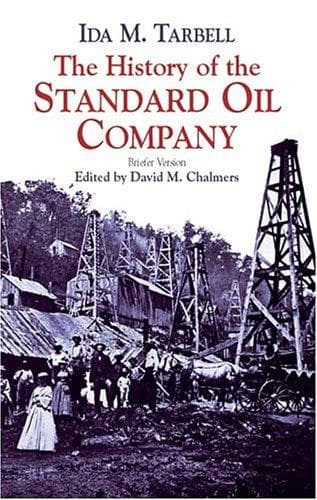
The History of the Standard Oil CompanyTarbell, Ida M. (Ida Minerva)
History
The History of the Standard Oil Company
Tarbell, Ida M. (Ida Minerva)
Petroleum industry and trade -- United States -- History; Standard Oil Company -- History
“The final agreement with the railways was scarcely blotter-dried
ere stealthy movements toward the whole line of outside refiners
were evident, although rather felt than seen. As long as
practicable, they were denied as mere rumours, but as they gradually
became accomplished victories, as one refiner after another, through
terror, through lack of skill in ventures, through financial
weakness, fell shivering with dislike into the embrace of this
commercial octopus, a sense of dread grew rapidly among those
independent interests which yet lived, and notably among a portion
of the railroad transporters.”
The chief “railroad transporter” who shared with the independents the
sense of dread which Mr. Rockefeller’s absorption of refineries awakened
was Mr. Potts himself. As he saw the independents of Pittsburg,
Philadelphia, New York and the creek, shutting down, selling out, going
into bankruptcy, while the Standard and its allies grew bigger day by
day, as he saw the Standard interest developing a system of
transportation greater than his own, he concluded to prevent, if
possible, the one shipper in the oil business. “We reached the
conclusion,” said Colonel Potts in 1888, “that there were three great
divisions in the petroleum business—the production, the carriage of it,
and the preparation of it for market. If any one party controlled
absolutely any one of those three divisions, it practically would have a
very fair show of controlling the others. We were particularly
solicitous about the transportation, and we were a little afraid that
the refiners might combine in a single institution, and some of them
expressed a strong desire to associate themselves permanently with us.
We therefore suggested to the Pennsylvania road that we should do what
we did not wish to do—associate ourselves. That is, our business was
transportation and nothing else; but, in order that we might reserve a
nucleus of refining capacity to our lines, we suggested we should become
interested in one or more refineries, and we became interested in two,
one in Philadelphia and one in New York. It was incidental merely to our
transportation. The extreme limit was 4,000 barrels a day only.”
Public-domain text, read in full here on John Shaqi.
Reviews
Reviews
No reviews yet
Be the first to share your thoughts on this work.
Elsewhere in the archive
Join the Discussion
Join the discussion
Sign in to leave a comment or review.
Sign InorCreate an account