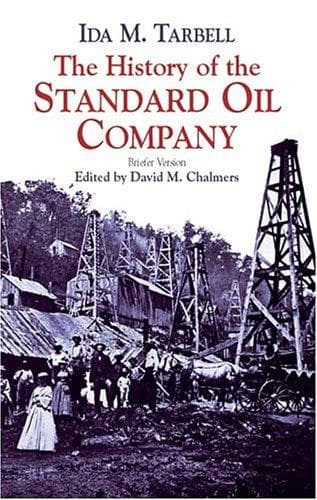
The History of the Standard Oil CompanyTarbell, Ida M. (Ida Minerva)
History
The History of the Standard Oil Company
Tarbell, Ida M. (Ida Minerva)
Petroleum industry and trade -- United States -- History; Standard Oil Company -- History
It was in the spring of 1876 that the Empire began to interest itself in
refineries. No sooner did Mr. Rockefeller discover this than he sought
Mr. Scott and Mr. Cassatt, then the third vice-president of the
Pennsylvania, in charge of transportation. It was not _fair_! Mr.
Rockefeller urged. The Empire was a transportation company. If it went
into the refining business it was not to be expected that it would deal
as generously with rivals as with its own factories; besides, it would
disturb the one shipper who, they all had agreed, was such a benefit to
the railroads. Mr. Scott and Mr. Cassatt might have reminded Mr.
Rockefeller that he was as truly a transporter as the Empire, but if
they did they were met with a prompt denial of this now well-known fact.
He was an oil refiner—only that and nothing more. “They tell us that
they do not control the United Pipe Lines,” Mr. Cassatt said in his
testimony in 1879. Besides, urged Mr. Rockefeller, if they have
refineries of course they will give them better terms than they do us.
Mr. Flagler told the Congressional Committee of 1888 that the Standard
was unable to obtain rates through the Empire Transportation Company
over the Pennsylvania Railroad for the Pittsburg or Philadelphia
refineries as low as were given by competing roads, and, added he, “from
the fact that the business during those years _was so very close as to
leave scarcely any margin of profit_ under the most advantageous
circumstances. And we, finding ourselves undersold in the markets by
competitors whom we knew had not the same facilities in the way of
mechanical appliances for doing the business, knew that there was but
one conclusion to be reached, and that was that the Empire
Transportation Company favoured certain other shippers, I would say
favoured its own refineries to our injury.”
As the Standard Oil Company paid a dividend of about fourteen per cent.
in both 1875 and 1876, besides spending large sums in increasing its
plants and facilities, the margin of profit cannot have been so low as
it seemed to Mr. Flagler in 1888 to have been; naturally enough, for he
saw dividends of from fifty to nearly 100 per cent. later.
[Illustration:
A. J. CASSATT IN 1877
Third vice-president of the Pennsylvania Railroad in charge of
transportation when first contract was made by that road with the
Standard Oil Company.
]
[Illustration:
GENERAL GEORGE B. MCCLELLAN
President of the Atlantic and Great Western Railroad at the time of
the South Improvement Company. General McClellan did not sign the
contract.
]
[Illustration:
GENERAL JAMES H. DEVEREUX
Who in 1868 as vice-president of the Lake Shore and Michigan Southern
Railroad first granted rebates to Mr. Rockefeller’s firm.
]
[Illustration:
JOSEPH D. POTTS
President of the Empire Transportation Company. Leader in the struggle
between the Pennsylvania Railroad and the Standard Oil Company in
1877.
]
Public-domain text, read in full here on John Shaqi.
Reviews
Reviews
No reviews yet
Be the first to share your thoughts on this work.
Elsewhere in the archive
Join the Discussion
Join the discussion
Sign in to leave a comment or review.
Sign InorCreate an account