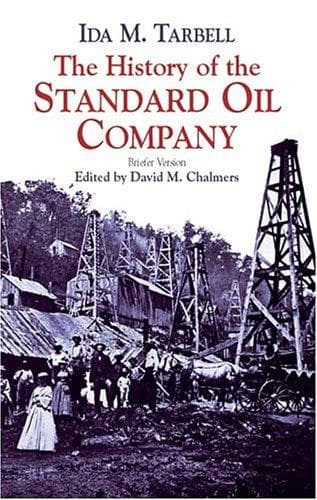
The History of the Standard Oil CompanyTarbell, Ida M. (Ida Minerva)
History
The History of the Standard Oil Company
Tarbell, Ida M. (Ida Minerva)
Petroleum industry and trade -- United States -- History; Standard Oil Company -- History
“Gentlemen,” he told them, “you cannot walk into this office and say we
are bound by any contract to do business with you at any price that any
other road does that is in competition with us; it is only on a fair
competitive basis, a fair competition for business at a price that I
consider will pay the company to do it.”
Soon after this interview, so rumour says, Mr. Vanderbilt sold the
Standard stock he had acquired as a result of the deals made through the
South Improvement Company. “I think they are smarter fellows than I am,
a good deal,” he told the commission, somewhat ruefully. “And if you
come in contact with them I guess you will come to the same conclusion.”
Spurred on then by resentment at the demands for new rebates, as well as
by the injustice of Mr. Rockefeller’s demand that the Empire give up its
refineries, the Pennsylvania accepted the Standard’s challenge, resolved
to stand by the Empire, and henceforth to treat all its shippers alike.
No sooner was its resolution announced in March, 1877, than all the
freight of the Standard, amounting to fully sixty-five per cent. of the
road’s oil traffic, was taken away. An exciting situation, one of
out-and-out war, developed, for the Empire at once entered on an
energetic campaign to make good its loss by developing its own
refineries, and by forming a loyal support among the independent oil
men. Day and night the officers worked on their problem, and with
growing success. When Mr. Rockefeller saw this he summoned his backers
to action. The Erie and Central began to cut rates to entice away the
independents. It is a sad reflection on both the honour and the
foresight of the body of oil men who had been crying so loudly for help,
that as soon as the rates were cut on the Standard lines many of them
began to attempt to force the Pennsylvania to follow. “They found the
opportunity for immediate profits by playing one belligerent against the
other too tempting to resist,” says Colonel Potts. “We paid them large
rebates,” said Mr. Cassatt; “in fact, we took anything we could get for
transporting their oil. In some cases we paid out in rebates more than
the whole freight. I recollect one instance where we carried oil to New
York for Mr. Ohlen, or someone he represented, I think at eight cents
less than nothing. I do not say any large quantities, but oil was
carried at that rate.”
Public-domain text, read in full here on John Shaqi.
Reviews
Reviews
No reviews yet
Be the first to share your thoughts on this work.
Elsewhere in the archive
Join the Discussion
Join the discussion
Sign in to leave a comment or review.
Sign InorCreate an account