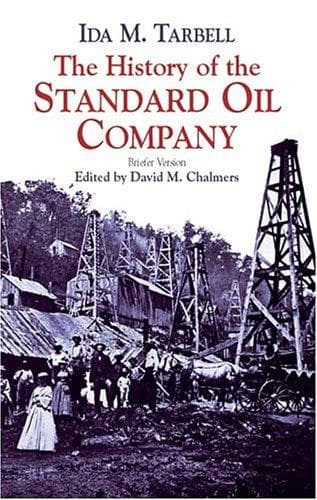
The History of the Standard Oil CompanyTarbell, Ida M. (Ida Minerva)
History
The History of the Standard Oil Company
Tarbell, Ida M. (Ida Minerva)
Petroleum industry and trade -- United States -- History; Standard Oil Company -- History
In spite of the growing bitterness and cost of the contest, the Empire
had no thought of yielding. Mr. Potts’s hope was in a firm alliance with
the independent oil men, many of the strongest of whom were rallying to
his side. At the beginning of the fight he had very shrewdly enlisted in
his plan one of the largest independent producers of the day, B. B.
Campbell, of Butler. “Being a pleasure and a duty to me,” says Mr.
Campbell, “I entered into the service with all the zeal and power that I
have. I made a contract with the Empire Line wherein I bound myself to
give all my business to this line.” At the same time Mr. Potts sought
the help of the man who was generally accepted as the coolest, most
intelligent, and trustworthy adviser in matters of transportation the
Oil Regions had, E. G. Patterson, of Titusville. Mr. Patterson was a
practical railroad man, and an able and logical opponent of the rebate
and “one shipper” systems. He had been prominent in the fight against
the South Improvement Company, and since that time he had persistently
urged the independents to wage war only on the practice of rebates—to
refuse them themselves and to hold the railroads strictly to their duty
in the matter. Several conferences were held, and finally, in the early
summer, Mr. Potts read the two gentlemen a paper he had drawn up as a
contract between the producers and the Empire. It speaks well for the
fair-mindedness of Mr. Potts that when he read this document to Mr.
Campbell and Mr. Patterson, both of whom were skilled in the ways of the
transporter, they “accepted it in a moment.”
“It was made the duty of Mr. Patterson and myself to get signatures of
producers to this agreement,” says Mr. Campbell, “in a sufficient amount
to warrant the Pennsylvania road entering into a permanent agreement.
The contract, I think, was for three years.” The attempt to enlist a
solid body of oil men in the scheme was at once set on foot, but hardly
was it under way before troubles of most serious import came upon the
Pennsylvania road. A great and general strike on all its branches tied
up its traffic for weeks. In Pittsburg hundreds of thousands of dollars’
worth of property were destroyed by a mob of railroad employees. It is
not too much to say that in these troubles the Pennsylvania lost
millions of dollars; it is certain that as a result of them the company
that fall and the coming spring had to pass its dividends for the first
time since it commenced paying them, and that its stock fell to
twenty-seven dollars a share (par being fifty dollars). Overwhelmed by
the disasters, Mr. Scott and Mr. Cassatt felt that they could not afford
any longer to sustain the Empire in its fight for the right to refine as
well as transport oil.
Public-domain text, read in full here on John Shaqi.
Reviews
Reviews
No reviews yet
Be the first to share your thoughts on this work.
Elsewhere in the archive
Join the Discussion
Join the discussion
Sign in to leave a comment or review.
Sign InorCreate an account