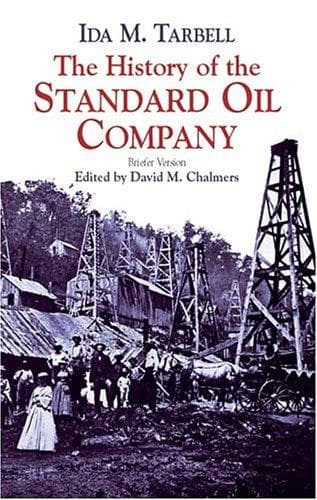
The History of the Standard Oil CompanyTarbell, Ida M. (Ida Minerva)
History
The History of the Standard Oil Company
Tarbell, Ida M. (Ida Minerva)
Petroleum industry and trade -- United States -- History; Standard Oil Company -- History
While the coffers of the Pennsylvania were empty, those of the Standard
were literally bursting with profits; for the Standard, the winter
before this fight came on, had carried to completion for the first time
the work which it had been organised to accomplish, that is, it had put
up the price of refined oil, in defiance of all laws of supply and
demand, and held it up for nearly six months. The story of this dramatic
commercial hold-up is told in the next chapter; it is enough for present
purposes to say that in the winter of 1876–1877 millions of gallons of
oil were sold by Mr. Rockefeller and his partners at a profit of from
fifteen to twenty-five cents a gallon. The curious can compute the
profits; they certainly ran into the multi-millions. A dividend of fifty
per cent. was paid for the year following the scoop, and “there was
plenty of money made to throw that dividend out twice over and make a
profit,” Samuel Andrews, one of the Standard’s leading men, told an Ohio
investigating committee in 1879. The Standard then had a war budget big
enough for any opposition, and it is not to be wondered at that the
Pennsylvania, knowing this and finding its own treasury depleted, was
ready to quit.
It was August when Mr. Scott and Mr. Cassatt decided to give up the
fight. Peace negotiations were at once instituted, Mr. Cassatt going to
Cleveland to see Messrs. Rockefeller and Flagler, and Mr. Warden, who
was visiting them there. Later, the same gentlemen met Mr. Scott and Mr.
Cassatt at the St. George Hotel, in Philadelphia. “The subject of
discussion at these meetings,” said Mr. Cassatt in 1879, when under
examination, “was whether we could not make some contract or agreement
with the Standard Oil Company by which this contest would cease. They
insisted that the first condition of their coming back on our line to
ship over our road must be that the Empire Transportation Company, which
company represented us in the oil business, must cease the refining of
oil in competition with them. The Empire Transportation Company objected
to going out of the refining business.” The result of this objection
Colonel Potts stated in 1888: “Our contract with the Pennsylvania road
gave to them the option, at any time they saw proper, upon reasonable
notice, of buying our entire plant; they exercised that option.” “Was
that at your request or desire?” the chairman asked the Colonel. “No,
sir. It was at the request of the Pennsylvania road through their
officials.” The question then came up as to who should buy the plant of
the Empire Transportation Company. “The Standard wanted us to do so,”
says Mr. Cassatt. “They wanted us to buy the pipe-lines and cars; we
objected to buying the pipe-lines, and it resulted in their buying them
and the refining plants. The negotiations were carried on in
Philadelphia, Mr. Rockefeller and Mr. Flagler mainly representing the
Standard. A substantial agreement was reached about the last of October.
Public-domain text, read in full here on John Shaqi.
Reviews
Reviews
No reviews yet
Be the first to share your thoughts on this work.
Elsewhere in the archive
Join the Discussion
Join the discussion
Sign in to leave a comment or review.
Sign InorCreate an account