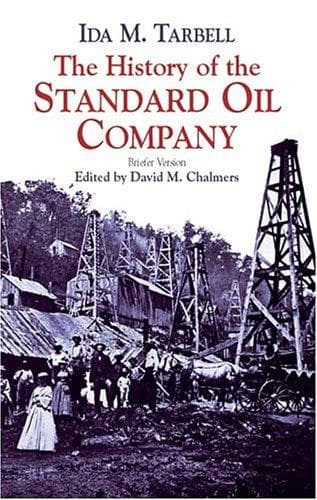
The History of the Standard Oil CompanyTarbell, Ida M. (Ida Minerva)
History
The History of the Standard Oil Company
Tarbell, Ida M. (Ida Minerva)
Petroleum industry and trade -- United States -- History; Standard Oil Company -- History
along with our full machinery under our contract, or under such
modification of that as we could fight through. We could not stop moving
a barrel of oil. We must be ready to take any offered to us; we must
supply parties taking oil. There was nothing we could do but what was
done; nothing was stopped, nothing is stopped, everything is going on
just as vigorously at this moment through as wide an extent of country
as ever it did, and it will continue to do so until after you take
action, until after we get these securities or the money. That, we
suppose, will be about six o’clock to-day, if you act favourably, and at
that time we shall, if everything goes through, telegraph to every man
in our service, and to the heads of departments what has been done, and
at twelve o’clock to-night we shall cease to operate anything in the
Empire Transportation Company.”
The stockholders accepted the proposition, and that night at Colonel
Potts’s office on Girard Street, Philadelphia, Mr. Scott and Mr.
Cassatt, of the Pennsylvania Railroad, Colonel Potts and two of his
colleagues in the Empire, and two of the refiners with whom he was
affiliated, met William Rockefeller, Mr. Flagler, Mr. Warden, Mr.
Lockhart, Charles Pratt, Jabez A. Bostwick, Daniel O’Day, and J. J.
Vandergrift, and their counsel, and the papers and checks were signed
and passed, wiping out of existence a great business to which a body of
the best transportation men the state of Pennsylvania has produced had
given twelve years of their lives. After the meeting was over, there
were sent out from Philadelphia to scores of employees of the Empire
Transportation Company scattered throughout the state, telegrams stating
that at twelve o’clock that night the company would cease to exist. For
twelve years the organisation had been doing a growing business. On the
date of this telegram its operations were more extensive, its
opportunities more promising, under fair play, than they had ever been
before in its history. The band of men who had built it up to such
healthy success were not giving it up because they had lost faith in it,
or because they believed there were larger opportunities for them in
some other business; they were giving it up because they were compelled
to, and probably men never went out of business in this country with a
deeper feeling of injustice than that of the officials of the Empire
Transportation Company on October 17, 1877, when they sent out the
telegrams which put their great creation into liquidation.
Public-domain text, read in full here on John Shaqi.
Reviews
Reviews
No reviews yet
Be the first to share your thoughts on this work.
Elsewhere in the archive
Join the Discussion
Join the discussion
Sign in to leave a comment or review.
Sign InorCreate an account