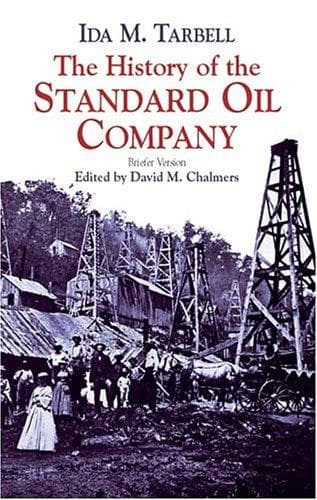
The History of the Standard Oil CompanyTarbell, Ida M. (Ida Minerva)
History
The History of the Standard Oil Company
Tarbell, Ida M. (Ida Minerva)
Petroleum industry and trade -- United States -- History; Standard Oil Company -- History
The pipe-lines thus acquired were at once consolidated with the other
Standard lines. Only a few independent lines, and only one of these of
importance—the Columbia Conduit—now remained in the Oil Regions. This
company had been doing business, since 1875, under the difficulties
already described. Dr. Hostetter, the chief stockholder, had become
heartily sick of the oil business and wanted to sell. He had approached
the Empire Line, and there had been some negotiations. Then came the
fall of the Empire and Dr. Hostetter sought the United Pipe Line. Intent
on stopping every outlet of oil not under their control the Standard
people bought the Columbia Conduit. By the end of the year the entire
pipe-line system of the Oil Regions was in Mr. Rockefeller’s hands. He
was the only oil gatherer. Practically not a barrel of oil could get to
a railroad without his consent. He had set out to be simply the only oil
refiner in the country, but to achieve that purpose he had been obliged
to make himself an oil transporter. In such unforeseen paths do great
ambitions lead men!
The first effect of the downfall of the Empire was a new railroad pool.
Indeed when it became evident that the Pennsylvania would yield, the
Erie, Central and the Standard had begun preparing a new adjustment, and
the papers for this were ready to be signed on October 17, with those
transferring the pipe-line property. Never had there been an arrangement
which gathered up so completely the oil outlets, for now the Baltimore
and Ohio road came into a pool for the first time. Mr. Garrett had
always refused the advances of the other roads, but when he saw that the
Columbia Conduit Line, his chief feeder, was sure to fall into Standard
hands; when he began to suspect the Baltimore refiners were going into
the combination, he realised that if he expected to keep an oil traffic
he must join the other roads. The new pool, therefore, was between four
roads. Sixty-three per cent. of the oil traffic was conceded to New
York, and of the sixty-three per cent. going there the Pennsylvania road
was to have twenty-one per cent. Thirty-seven per cent. of the traffic
was to go to Philadelphia and Baltimore, and of this thirty-seven per
cent. the Pennsylvania had twenty-six per cent. The Standard guaranteed
the road not less than 2,000,000 barrels a year, and if it failed to
send that much over the road it was to pay it a sum equal to the profits
it would have realised upon the quantity in deficit. In return for this
guarantee of quantity the Standard was to pay such rates as might be
fixed from time to time by the four trunk lines (which rates it was
understood should be so fixed by the trunk lines as to place them on a
parity as to cost of transportation by competing lines), and it was to
receive weekly a commission of ten per cent. on its shipments it
controlled.[56] No commission was to be allowed any other shipper unless
he should guarantee and furnish such a quantity of oil that after
Public-domain text, read in full here on John Shaqi.
Reviews
Reviews
No reviews yet
Be the first to share your thoughts on this work.
Elsewhere in the archive
Join the Discussion
Join the discussion
Sign in to leave a comment or review.
Sign InorCreate an account