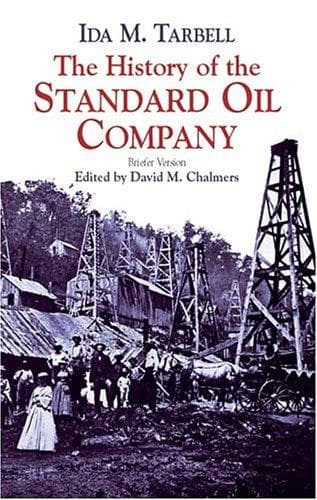
The History of the Standard Oil CompanyTarbell, Ida M. (Ida Minerva)
History
The History of the Standard Oil Company
Tarbell, Ida M. (Ida Minerva)
Petroleum industry and trade -- United States -- History; Standard Oil Company -- History
The effect of this new concentration of power was immediate in all the
refining centres of the country. Most of the Baltimore refiners, some
eight in number, which up to this time had remained independent, seeing
themselves in danger of losing their oil supply, were united at the end
of 1877 into the Baltimore United Oil Company, with J. N. Camden at
their head. Mr. Camden was president of the Camden Consolidated Company
of Parkersburg, West Virginia, a concern already in the Standard
alliance, and he and his partners held the majority stock in the
Baltimore concern. The method of reaching the Baltimore independents who
looked with dislike or fear on the Standard was a familiar one: An
officer of one of the concerns owned by the Standard Oil Company would
approach the outsider who was feeling the pressure and propose a sale or
a lease to himself personally. It was an escape, and it usually ended in
the complete absorption of the plant by the Standard. A few of the
Baltimore interests refused to go into the Baltimore United Oil Company.
Among them was a woman, a widow, Mrs. Sylvia C. Hunt, who had conducted
a successful refinery there for several years, and whose business
ability and energy had been the admiration of all those with whom she
had come in contact. Her interests had been particularly cherished by
the Empire Line, “Mrs. Hunt’s cars” being given precedence many a time
by agents at Titusville or other shipping points who knew her story. In
the summer of 1877 her works burned out. With a courage which was
generally commented on at the time Mrs. Hunt at once rebuilt and in less
than six months had her plant in running order. Then came the fall of
the Empire Transportation Company, the sale of the Columbia Conduit
Company, and the entrance of the Baltimore and Ohio into the Oil Pool.
Every refiner in Baltimore knew what that meant, and the wise sold when
Mr. Camden proposed it. Mrs. Hunt, however, did not want to sell. She
distrusted the new company. Finally with many misgivings she leased for
five years at $5,000 a year. It was less than half she had been making,
so she claimed, and among her old friends there was much indignation.
Colonel Potts, indeed, in telling her story in his “Brief History of the
Standard Oil Company,” said: “It could fairly have been expected that
something of chivalrous feeling would be inspired by the sight of this
indomitable spirit who had wrought so noble a work against such great
odds. But though fine sentiments and generous words find frequent exodus
from the lips of the Standard managers, they are never seconded by
generous deeds. They crushed her business and her spirit as
remorselessly as they would have killed a dog.” These are bitter words
written when Colonel Potts was still smarting from his defeat. They were
written, too, without reflection that Mrs. Hunt, if allowed to have all
the oil she wanted, allowed equal rates, allowed to use her ability and
Public-domain text, read in full here on John Shaqi.
Reviews
Reviews
No reviews yet
Be the first to share your thoughts on this work.
Elsewhere in the archive
Join the Discussion
Join the discussion
Sign in to leave a comment or review.
Sign InorCreate an account