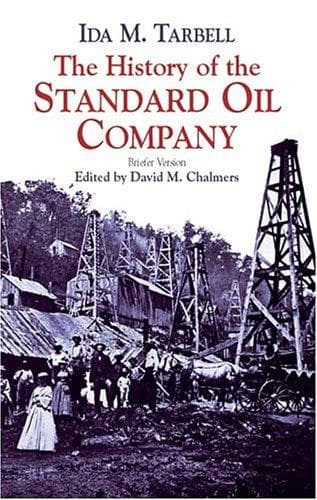
The History of the Standard Oil CompanyTarbell, Ida M. (Ida Minerva)
History
The History of the Standard Oil Company
Tarbell, Ida M. (Ida Minerva)
Petroleum industry and trade -- United States -- History; Standard Oil Company -- History
deducting any commission allowed, the road realised from it the same
amount of profits as it did from the Standard trade. The points in the
agreement were embodied in a letter from William Rockefeller to Mr.
Scott. This letter and the answer declaring the arrangement to be
satisfactory to the company are both dated October 17.[57]
Four months later Mr. Rockefeller was able to take another step of great
advantage. He was able to put into operation the system of drawbacks on
other people’s shipments which the South Improvement Company contracts
had provided for, and which up to this point he seems not to have been
securely enough placed to demand. There were no bones about the request
now. Mr. O’Day, the general manager of the American Transfer Company, a
pipe-line principally in Clarion County, Pennsylvania, which, including
its branches, was from eighty to 100 miles in length, a company now one
of the constituents of the United Pipe Line, wrote to Mr. Cassatt:
“I here repeat what I once stated to you, and which I wish you to
receive and treat as strictly confidential, that we have been for
many months receiving from the New York Central and Erie Railroads
certain sums of money, in no instance less than twenty cents per
barrel on _every barrel of crude oil carried by each of these
roads_.” Continuing, Mr. O’Day says: “Co-operating as we are doing
with the Standard Oil Company and the trunk lines in every effort to
secure for the railroads paying rates of freight on the oil they
carry, I am constrained to say to you that in justice to the
interests I represent we should receive from your company at least
twenty cents on each barrel of crude oil you transport.... In
submitting this proposition I find that I should ask you to let this
date from November 1, 1877, but I am willing to accept as a
compromise (which is to be regarded as strictly a private one
between your company and ours) the payment by you of twenty cents
per barrel on all crude oil shipments commencing with February 1,
1878.”[58]
Mr. Cassatt complied with Mr. O’Day’s request. In a letter to the
comptroller of the road he said that he had agreed to allow this
commission after having seen the receipted bills, showing that the New
York Central allowed them a commission of thirty-five cents a barrel,
and the Erie Railroad a commission of twenty cents a barrel on Bradford
oil and thirty cents on all other oils. Thus the Standard Oil Company,
through the American Transfer Company, received, in addition to rebates
on its own shipments, from twenty to thirty-five cents drawback a barrel
on all crude oil which was sent over the trunk lines by other people as
well as by itself.[59]
Public-domain text, read in full here on John Shaqi.
Reviews
Reviews
No reviews yet
Be the first to share your thoughts on this work.
Elsewhere in the archive
Join the Discussion
Join the discussion
Sign in to leave a comment or review.
Sign InorCreate an account