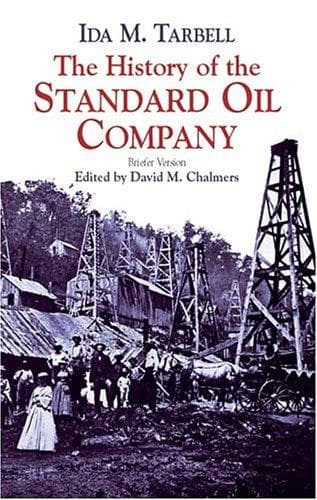
The History of the Standard Oil CompanyTarbell, Ida M. (Ida Minerva)
History
The History of the Standard Oil Company
Tarbell, Ida M. (Ida Minerva)
Petroleum industry and trade -- United States -- History; Standard Oil Company -- History
It is undoubtedly true, as Mr. Rockefeller avers, that Mrs. B—— was not
obliged to sell out, but the fate of those who in this period of
absorption refused to sell was before her eyes. She had seen the twenty
Cleveland refineries fall into Mr. Rockefeller’s hands in 1872. She had
watched the steady collapse of the independents in all the refining
centres. She had seen every effort to preserve an individual business
thwarted. Rightly or wrongly she had come to believe that a refusal to
sell meant a fight with Mr. Rockefeller, that a fight meant ultimately
defeat, and she gave up her business to avoid ruin.
CHAPTER SEVEN
THE CRISIS OF 1878
A RISE IN OIL—A BLOCKADE IN EXPORTS—PRODUCERS DO NOT GET THEIR SHARE
OF THE PROFITS—THEY SECRETLY ORGANISE THE PETROLEUM PRODUCERS’ UNION
AND PROMISE TO SUPPORT PROPOSED INDEPENDENT PIPE-LINES—ANOTHER
INTERSTATE COMMERCE BILL DEFEATED AT WASHINGTON—“IMMEDIATE
SHIPMENT”—INDEPENDENTS HAVE TROUBLE GETTING CARS—RIOTS
THREATENED—APPEAL TO GOVERNOR HARTRANFT—SUITS BROUGHT AGAINST UNITED
PIPE-LINES, PENNSYLVANIA RAILROAD AND OTHERS—INVESTIGATIONS
PRECIPITATED IN OTHER STATES—THE HEPBURN COMMISSION AND THE OHIO
INVESTIGATION—EVIDENCE THAT THE STANDARD IS A CONTINUATION OF THE
SOUTH IMPROVEMENT COMPANY—PRODUCERS FINALLY DECIDE TO PROCEED
AGAINST STANDARD OFFICIALS—ROCKEFELLER AND EIGHT OF HIS ASSOCIATES
INDICTED FOR CONSPIRACY.
It was clear enough by the opening of 1878 that Mr. Rockefeller need no
longer fear any serious trouble from the refining element. To be sure
there were scattered concerns still holding out and some of them doing
very well; but his latest move had put him in a position to cut off or
at least seriously to interfere with the very raw material in which they
worked. It was hardly to be expected after the defeat of the
Pennsylvania that any railroad would be rash enough to combine with even
a strong group of refiners. As for independent pipe-lines, there were so
many ways of “discouraging” their building that it did not seem probable
that any one would ever go far. It was only a matter of time, then, when
all remaining outside refiners must come into his fold or die. Mr.
Rockefeller’s path would now have been smooth had it not been for the
oil producers. But the oil producers, naturally his enemy, he being the
buyer and they the seller, had become in the six years before Mr.
Rockefeller had made himself the only gatherer of their oil,
irreconcilable opponents of whatever he might do. The South Improvement
Company they regarded rightly enough as devised to control the price of
their product, and that scheme they wrongfully laid entirely at Mr.
Rockefeller’s door. Mr. Rockefeller had been only one of the originators
of the South Improvement Company, but the fact that he had become later
practically its only supporter, that he was the only one who had
Public-domain text, read in full here on John Shaqi.
Reviews
Reviews
No reviews yet
Be the first to share your thoughts on this work.
Elsewhere in the archive
Join the Discussion
Join the discussion
Sign in to leave a comment or review.
Sign InorCreate an account