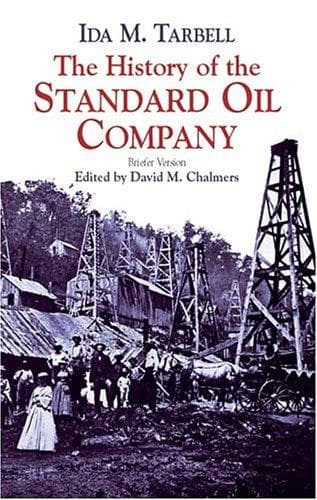
The History of the Standard Oil CompanyTarbell, Ida M. (Ida Minerva)
History
The History of the Standard Oil Company
Tarbell, Ida M. (Ida Minerva)
Petroleum industry and trade -- United States -- History; Standard Oil Company -- History
profited by it, and that he had turned his Cleveland plant into a
machine for carrying out its provisions, had caused the oil country to
fix on him the entire responsibility. Then the oil men’s experience with
Mr. Rockefeller in 1873 had been unfortunate. They charged the failure
of their alliance to his duplicity. There is no doubt that Mr.
Rockefeller played a shrewd and false game with the oil men in 1873, but
the failure of their alliance was their own fault. They did not hold
together—they failed to limit their production as they agreed, they
suspected one another, and at a moment, when, if they had been as
patient and wise as their great opponent they would have had the game in
their own hands, and him at their feet, as he had been in 1872, for the
sake of immediate returns, they abandoned some of the best features of
their organisation, and allied themselves with a man they distrusted.
When that alliance failed they threw on Mr. Rockefeller’s shoulders a
blame which they should have taken on their own.
Another very real cause for their anxiety and dislike was that as the
refiners’ alliance progressed the refiners made a much larger share of
the profits than the producers thought fair. The abandoning of their
alliance in 1873 had of course put an end to their measures for limiting
production and for holding over-production until it could be sold at the
prices they thought profitable. The drill had gone on merrily through
1873, 1874, and 1875, regardless of consumption or prices. By the end of
1874 there were over three and a half million barrels of oil in stock,
more than twice what there had ever been before. Production was well to
a million barrels a month and prices that year averaged but $1.15 a
barrel. For men who considered three dollars a starvation price this was
indeed hard luck. Things looked better by the end of 1875, for
production was falling off. By March, 1876, stocks had been so reduced
that there was strong confidence that the price of crude oil must
advance. By June the Oil City Derrick began to prophesy “three-dollar
oil” and to advise oil men to hold crude for that price. In August three
dollars was reached in the Oil City exchange. It had been nearly four
years since that price had been paid for oil, and the day the point was
reached (August 25) the brokers fairly went mad. They jumped on their
chairs, threw up their hats, beat one another on the back, while the
spectators in the crowded galleries, most of them speculators, yelled in
sympathy. Before six o’clock that day oil reached $3.11¼. Nobody thought
of stopping because it was supper time. The exchange was open until
nearly midnight, prices booming on to $3.17½. It seemed like old times
in the Oil Region—the good old flush times when people made a fortune
one day and threw it away the next!
Public-domain text, read in full here on John Shaqi.
Reviews
Reviews
No reviews yet
Be the first to share your thoughts on this work.
Elsewhere in the archive
Join the Discussion
Join the discussion
Sign in to leave a comment or review.
Sign InorCreate an account