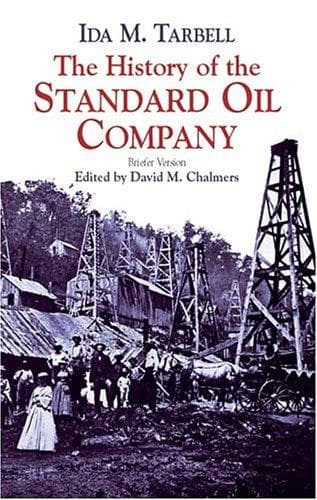
The History of the Standard Oil CompanyTarbell, Ida M. (Ida Minerva)
History
The History of the Standard Oil Company
Tarbell, Ida M. (Ida Minerva)
Petroleum industry and trade -- United States -- History; Standard Oil Company -- History
organisation was held, “the Petroleum Parliament” or “Congress” it was
called. This Congress, which met in Titusville, was composed of 172
delegates. It was claimed that it represented at least 2,000 oil
producers, and not less than seventy-five millions in money. It is
certain it included the representative men of the Oil Regions, those to
whose daring, hard work, and energy the discovery and development of the
oil fields, as they were known at that time, were entirely due.
[Illustration:
WOODEN CAR TANKS
]
[Illustration:
BOILER TANK CARS
]
[Illustration:
WOODEN TANKS FOR STORING OIL
]
[Illustration:
RAILROAD TERMINAL OF AN EARLY PIPE LINE
]
For four days the Congress was in session, and it is a remarkable
comment on the seriousness with which it had undertaken its work that,
although reporters from all parts of the country interested in oil were
present, nothing leaked out. In December a second session of four days
was held in Titusville, but no announcement of what was doing was made
to the press. Indeed, it was only as lines of action developed that the
public became familiar with what the producers had resolved on in the
days of secret session which they had held.
Their resolutions had been eminently wise and they undertook their
support vigorously and intelligently. First and foremost they resolved
to stand by all efforts to secure an outlet to the seaboard independent
of the Standard and the allied railroads. Two enterprises were put
before them at once. The first was what was known as the Equitable
Petroleum Company, an organisation started by one of the most
resourceful and active independent men in the oil country, one of whom
we are to hear more, Lewis Emery, Jr. This company, in which some 200
oil producers in the Bradford field had taken stock, proposed to lay a
pipe-line to Buffalo and to ship their oil thence by the Erie Canal.
They had acquired a right of way to Buffalo and had capital pledged to
carry out the project. The second enterprise to come before the newly
formed union was much more ambitious. It was nothing less than a revival
of Mr. Harley’s enterprise which had attracted so much attention in
1876. It was revived now by the three men who had been operating the
Columbia Conduit Line under a lease—Messrs. Benson, McKelvy and Hopkins,
who had been set free by the sale of that property to the Standard.
Their experience with the pipe-line business had convinced them it was
one of the most lucrative departments of the oil industry. They believed
too that oil could be pumped over the mountains, and no sooner were they
free than they took up Mr. Harley’s old idea and engaged the same
engineer he had brought into the enterprise, General Herman Haupt, to
survey a route from Brady’s Bend on the Allegheny River to Baltimore,
Maryland—a distance of 235 miles. To both of these projects the General
Council of the Union gave promise of support.
Public-domain text, read in full here on John Shaqi.
Reviews
Reviews
No reviews yet
Be the first to share your thoughts on this work.
Elsewhere in the archive
Join the Discussion
Join the discussion
Sign in to leave a comment or review.
Sign InorCreate an account