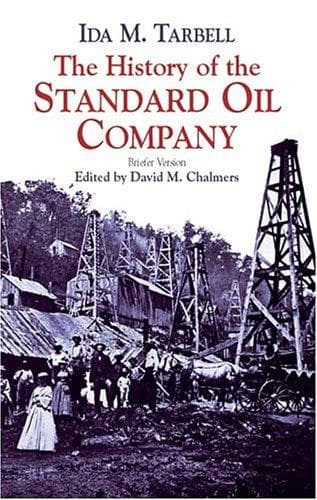
The History of the Standard Oil CompanyTarbell, Ida M. (Ida Minerva)
History
The History of the Standard Oil Company
Tarbell, Ida M. (Ida Minerva)
Petroleum industry and trade -- United States -- History; Standard Oil Company -- History
With the yielding of the exporter exactly what they feared occurred, the
price was raised! The exporters balked again. The matter began to
attract public attention. The New York Herald was particularly active in
airing the situation and did not hesitate to denounce it as a “Petroleum
Plot.” The leaders were interviewed, among them Mr. Rockefeller. Mr.
Rockefeller still held to his theory that to make oil dear was worthy of
public approval. They had aimed to control the price of oil in a
perfectly legitimate way, he told the Herald reporter, and the exporters
would have to yield to their prices. By the end of October New York
harbour was full of vessels—a mute protest against the corner—and it was
not until November that the exporters fully gave in and began to take
all the oil they could get at prices asked, which ranged from twenty-six
to thirty-five cents. And these prices were held all through the winter
of 1876–77, up to February 22. They were held regardless of the price of
crude, for, do their utmost, the producers could not keep their oil up
to the corresponding price of refined. According to the scale of
relative prices then accepted, twenty-six cents a gallon for refined
meant five dollars a barrel for crude, yet there was not a month in the
entire period of this hold-up that crude averaged that price. In
December, when the average price of refined was 29⅜ cents, crude was but
$3.78⅛ a barrel. The producers held meetings and passed resolutions,
cursed the refiners and talked of building independent refineries,
filled the columns of the Derrick with open letters advocating a
shut-down, an alliance of their own, restrictive legislation, an oil
men’s railway, and what was more to the point some of them supported,
with more or less fidelity, the efforts to build up counter movements
noted in the last chapter: the Columbia Conduit Line, the seaboard
pipe-line, and especially the alliance with the Empire Transportation
Company, attempted in the spring of 1877. There seemed more hope in this
last combination than in any other movement, for they had faith in
Colonel Potts, and besides they were accustomed to seeing the
Pennsylvania Railroad get what it wanted. The defeat of the Pennsylvania
was therefore the heavier blow. Indeed, the news of the sale of the
Empire pipe-lines to the Standard was like the sounding of the tocsin in
the angry and baffled Oil Regions. It revived the spirit of 1872. But it
was the spirit of 1872 with new dignity and a discretion such as had
never been before seen in the blatant region. In every town from McKean
County southwest to Butler the oil towns hastened to organise themselves
into a secret society. Little by little it came out that a Producers’
Union had been organised. From all that could be learned it looked very
much as if the Petroleum Producers’ Union had come into existence to do
business. On November 21, 1877, the first meeting of the new
Public-domain text, read in full here on John Shaqi.
Reviews
Reviews
No reviews yet
Be the first to share your thoughts on this work.
Elsewhere in the archive
Join the Discussion
Join the discussion
Sign in to leave a comment or review.
Sign InorCreate an account