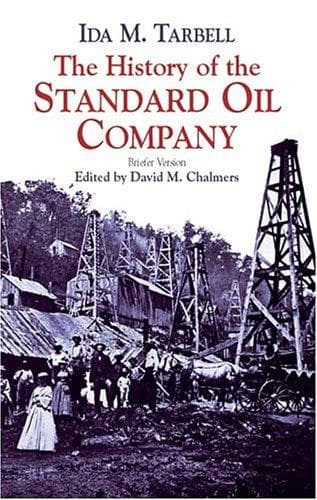
The History of the Standard Oil CompanyTarbell, Ida M. (Ida Minerva)
History
The History of the Standard Oil Company
Tarbell, Ida M. (Ida Minerva)
Petroleum industry and trade -- United States -- History; Standard Oil Company -- History
On every side indeed the producers hastened to protect themselves
against the Lord of the Oil Regions, as Mr. Rockefeller, not inaptly,
was called, on the completion of his pipe-line monopoly. That they were
not merely alarmists in thinking that they must do something to protect
their interests was demonstrated sooner than was anticipated. The
demonstration was hurried by an unforeseen and difficult situation—a
great outpouring of oil in a new field—the Bradford or Northern Field in
McKean County, Pennsylvania. About the time that Mr. Rockefeller’s
lordship was realised it became certain that a deposit of oil had been
discovered which was going to lead soon to a production vastly in excess
of the consumption, as well as in excess of the then existing facilities
for gathering and storing oil. If Mr. Rockefeller wished to keep his
monopoly he must, it was evident, enter upon a campaign of expansion
calling for an immense expenditure of energy and money. He must lay
pipes in a hundred directions to get the output of new wells; he must
build tanks holding thousands of barrels to receive the oil. And all of
this must be done quickly if rivals were to be kept out of the way.
There was no hesitation on the part of the United Pipe Lines. One of the
greatest construction feats the country has ever seen was put through in
the years 1878, 1879 and 1880 in the Bradford oil field by the Standard
interests. It was a wonderful illustration of the surpassing
intelligence, energy and courage with which the Standard Oil Company
attacks its problems. But while it was putting through this feat it
instituted a policy toward the producers which was regarded by them as
tyrannical and unjustifiable. The first manœuvre in this new policy hit
the producer in a very tender spot, for it concerned the price he was to
receive for oil.
The method which prevailed at the time in handling and buying and
selling oil was this: At the request of the well owner connected with a
pipe-line his oil was run and credited to him in the pipe-line office.
Here he could hold it as long as he wished by paying a storage charge.
If he wished to sell his “credit balance,” as oil to his account was
called, he simply gave the buyer an order on the line for the oil, and
it was transferred to the account of the new buyer. The pipe-lines
frequently had hundreds of thousands of barrels of oil in hand, and they
traded with this oil as banks do with their deposits—that is, they
issued certificates for each 1,000 barrels of oil on hand, and these
certificates were negotiable like any other paper. Now the United Pipe
Lines acknowledged itself a common carrier, and so was obliged to
discharge the duty of collecting oil on demand, or at least within a
reasonable time after the demand of its patrons.
Public-domain text, read in full here on John Shaqi.
Reviews
Reviews
No reviews yet
Be the first to share your thoughts on this work.
Elsewhere in the archive
Join the Discussion
Join the discussion
Sign in to leave a comment or review.
Sign InorCreate an account