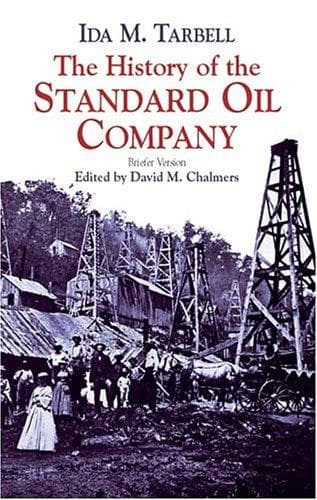
The History of the Standard Oil CompanyTarbell, Ida M. (Ida Minerva)
History
The History of the Standard Oil Company
Tarbell, Ida M. (Ida Minerva)
Petroleum industry and trade -- United States -- History; Standard Oil Company -- History
But in December, 1877, after the monopoly was completed, they refused to
discharge their obligations in the customary way. On the plea that they
had not sufficient tankage to carry oil in the Bradford field, they
issued an order that no oil would be run in that district for any one
unless it was sold for “immediate shipment”—that is, no oil would be
taken to hold for storage; it would be taken for shipping only. At the
same time the Standard buyer, J. A. Bostwick, decreed that henceforth no
Bradford oil would be bought for immediate shipment unless it was
offered at _less_ than the market price. No fixed discount was set. The
seller was asked what he would take; his offer was, of course, according
to his necessities. Even then an answer was not always immediately
given. The seller was told to come back in five or ten days and he would
be told if his oil would be taken. A feature of the new order,
particularly galling to the oil men, was the manner in which it was
enforced. Formerly the buyer and seller had met freely in the oil
exchanges and their business offices, and transactions had been carried
on as among equals. Now the producers were obliged to form in line
before the United Pipe Lines’ offices and to enter one at a time to
consult the buyer. A line of a hundred men or more often stood during
the hours set before the office, waiting their turn to dispose of their
oil. It should be said in justice to Mr. Bostwick that he was not the
first buyer to take oil at a discount. The producers themselves
frequently offered oil at less than the market price when in need of
money, but Mr. Bostwick was the first buyer in a situation to force them
to make the discount regularly. When these orders came, few of the
producers had sufficient private tankage to take care of any amount of
oil. Here was the situation then: to keep oil from running on the ground
the producer must sell it; but if he sold it he must take a price from
two to twenty-five cents or more below the market.
Public-domain text, read in full here on John Shaqi.
Reviews
Reviews
No reviews yet
Be the first to share your thoughts on this work.
Elsewhere in the archive
Join the Discussion
Join the discussion
Sign in to leave a comment or review.
Sign InorCreate an account