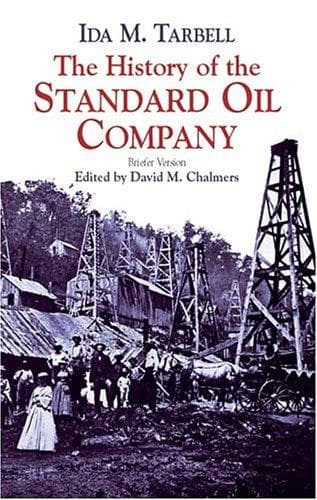
The History of the Standard Oil CompanyTarbell, Ida M. (Ida Minerva)
History
The History of the Standard Oil Company
Tarbell, Ida M. (Ida Minerva)
Petroleum industry and trade -- United States -- History; Standard Oil Company -- History
The immediate shipment order was not an invention of the United Pipe
Lines. It had been enforced more than once for brief periods by various
lines when they found their capacity overcrowded by some unexpected
situation. In 1872 epizootic among the horses so upset things in the Oil
Regions that for a short time an immediate shipment order was enforced.
In 1874, when the pipe-lines were overtaxed by a great outpouring of oil
in the Lower Field, immediate shipment had been attempted, but at that
time there were still so many independent pipes struggling for business
that the movement met no success. Now, however, the United Pipe Lines
had things its own way. That they were not ready to meet the growing
Bradford production is plain from a study of the figures. There were in
the Oil Regions at the close of 1877, according to the Oil City Derrick,
4,000,000 barrels of tankage. There was on hand at this time 3,127,837
barrels of oil, but the empty tankage was in the wrong place. In the
Bradford field, where the daily production had suddenly increased from
2,000 barrels in January to 8,451 barrels in December, there was only a
little over 200,000 barrels of tankage.[66] In order to take care of the
oil the pipe-lines began to make nearly all their shipments from that
field, and oil piled up in the Lower Region to the great dissatisfaction
of the producers there.
As soon as the situation of the Bradford field was realised both the
United Pipes and the producers began a furious campaign of tank
building. By the beginning of April, 1878, the tankage there had been
increased to 1,152,028 barrels.[67] Between April 1 and November 1
seventy tanks of from 10,000 to 25,000 barrels capacity were built in
McKean County. The greater number of these belonged to the producers.
According to the United Pipe Lines’ statement, there was under their
control in the entire Oil Regions in October 5,200,000 barrels of
tankage, two-thirds of which belonged to producers, but was held by them
under a lease.[68] But oil poured from the ground faster than tanks
could be built. In six months—that is, by July, 1878,—the daily output
of Bradford had become over 18,000 barrels, an increase of 10,000
barrels a day over that of the previous December. That it was a most
difficult situation for everybody is evident. There was but one way to
prevent loss—shut down the wells and stop the drill; but this the
producers refused to consider. Of course the price of oil went down
rapidly, so far did the production exceed consumption. But why, cried
the producer, when oil is already so low, take advantage of our
necessity and force us into competition with each other; why enforce
this immediate shipment? They answered their question themselves, and
began then to make a charge against the Standard, which they continue to
make to-day; that is, that it habitually meets the extraordinary
expenses to which it is put by depressing the price of crude oil—“taking
Public-domain text, read in full here on John Shaqi.
Reviews
Reviews
No reviews yet
Be the first to share your thoughts on this work.
Elsewhere in the archive
Join the Discussion
Join the discussion
Sign in to leave a comment or review.
Sign InorCreate an account