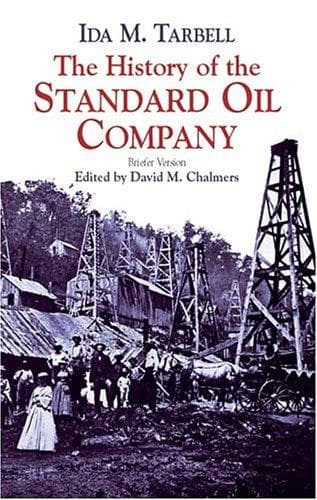
The History of the Standard Oil CompanyTarbell, Ida M. (Ida Minerva)
History
The History of the Standard Oil Company
Tarbell, Ida M. (Ida Minerva)
Petroleum industry and trade -- United States -- History; Standard Oil Company -- History
The only thing which prevented a riot at this time and great destruction
of property, if not of life, was the strong hand the Petroleum
Producers’ Union had on the country. Fearing that if violence did occur
the different movements they had under way would be prejudiced, they
sent a committee of twenty-five men to Harrisburg to see Governor
Hartranft. They laid before him and the attorney-general of the state
the grievance of the oil producers in an “appeal” reviewing the history
of the industry.[71] They demanded that the United Pipe Lines be made to
perform its duty as a public carrier, and the railroads be made to cease
their discrimination against shippers both in the matter of rebates and
in furnishing cars. They called the Governor’s attention to the fact
that there were already existing laws touching these matters which, in
their judgment, met the case, and if the existing laws did not give them
relief, that it was the plain duty of the executive to call a meeting of
the Legislature and pass such acts as would do so. Governor Hartranft
was much stirred by the story of the producers. He went himself to the
Oil Regions to see the situation, and in August directed the producers
to put their demands into the form of an appeal. This was done, and it
was decided to bring proceedings by writ of _quo warranto_ against the
United Pipe Lines, and by separate bills in equity against the
Pennsylvania Railroad and the other lines doing business in the state.
It was September before the state authorities began their investigation
of the United Pipe Lines, the hearings being held in Titusville. Many
witnesses summoned failed to appear, but enough testimony was brought
out in this investigation to show that the railroads had refused to
furnish cars for independents when they had them empty, and that the
United Pipe Lines had clearly violated its duty as a common carrier. In
his report on this investigation the secretary of internal affairs,
William McCandless, rendered a verdict that the charges of the oil
producers had not been substantiated in any way that demanded action.
The indignation which followed this report was intense. It found a vent
in the hanging in effigy of McCandless, who was universally known in the
state as “Buck.” In the oil exchange at Parker, on the morning of
October 19, the figure of a man was found hanged by the neck to a
gallows, and the producers left it hanging there all day, so that they
might jeer and curse it. Across the forehead of the effigy in large
blood-red letters were the words:
...........................
. .
. PENNSYLVANIA RAILROAD .
. .
...........................
Pinned to the gallows there was a card bearing a quotation from
Secretary McCandless’s report:
Public-domain text, read in full here on John Shaqi.
Reviews
Reviews
No reviews yet
Be the first to share your thoughts on this work.
Elsewhere in the archive
Join the Discussion
Join the discussion
Sign in to leave a comment or review.
Sign InorCreate an account