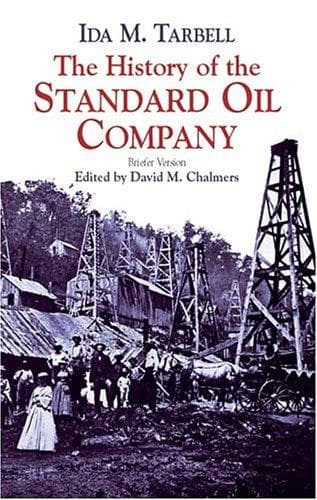
The History of the Standard Oil CompanyTarbell, Ida M. (Ida Minerva)
History
The History of the Standard Oil Company
Tarbell, Ida M. (Ida Minerva)
Petroleum industry and trade -- United States -- History; Standard Oil Company -- History
Now, while the railroads were refusing cars to independent shippers,—or
if they gave an order for them, the United Pipe Lines were refusing to
load them,—while the Standard and the railroads were doing their utmost
to prevent the Equitable Line doing business, and were discouraging in
every way the seaboard pipe-line—new routes which would take care of a
proportion, at least, of the oil which they claimed they could not
handle—thousands of barrels of oil were running on the ground in
Bradford, and two of the independent refineries of New York shut down
entirely in order that a third of their number might get oil enough to
fill an order.
This interference with the outside interests, thus preventing the small
degree of relief which they would have afforded, and a growing
conviction that the Standard meant to keep up the “immediate shipment”
order, at least until it had built the pipes and tanks needed in the
Bradford field, finally aroused the region to a point where riot was
imminent. The long line of producers who filed into the United Pipe
Lines’ office day after day to sell their oil at whatever prices they
could get for it, and who, having put in an offer which varied according
to their necessities, were usually told to come back in ten days, and
the buyer would see whether he wanted it or not—this long line of men
began to talk of revolution. Crowds gathered about the offices of the
Standard threatening and jeering. Mysterious things, cross-bones and
death-heads, were found plentifully sprinkled on the buildings owned by
the Standard interests. More than once the slumber of the oil towns was
disturbed by marching bodies of men. It was certain that a species of
Kuklux had hold of the Bradford region, and that a very little spark was
needed to touch off the United Pipe Lines. In the meantime things were
scarcely less exciting in the Lower Fields. The “immediate shipment”
order was looked upon there as particularly outrageous, because there
was no lack of lines or tanks in that field, and when, in the summer of
1878, there was added to this cause an unjustifiable scarcity of cars,
excitement rose to fever heat.
Public-domain text, read in full here on John Shaqi.
Reviews
Reviews
No reviews yet
Be the first to share your thoughts on this work.
Elsewhere in the archive
Join the Discussion
Join the discussion
Sign in to leave a comment or review.
Sign InorCreate an account