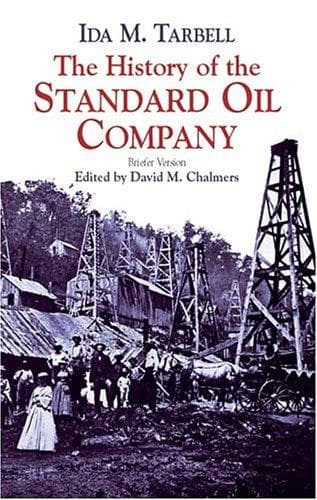
The History of the Standard Oil CompanyTarbell, Ida M. (Ida Minerva)
History
The History of the Standard Oil Company
Tarbell, Ida M. (Ida Minerva)
Petroleum industry and trade -- United States -- History; Standard Oil Company -- History
Another offensive clause of the 1872 contracts was that pledging the
railroads to lower or raise the gross rates of transportation for such
times and to such extent as might be necessary to overcome competition.
Now, the new contracts of the Standard provided the same arrangement;
that is, they stipulated that the rates were to be lowered if necessary
so as to place the Standard on a parity with shippers by competing
lines. The workings of the clause were illustrated when the producers
got the Equitable Line through in 1878, the railroads dropping their
charge to eighty cents a barrel, and in some cases even less. The
producers certainly had evidence enough for their claim that the
contracts of the South Improvement Company and the Standard Oil Company
with the railroads were similar in every particular as far as principles
were concerned—that they differed alone in the amounts of the rebates
and drawbacks.
There was plenty of evidence brought out, also, to show that the object
of the Standard operations was like that of the South Improvement
Company—keeping up the price of refined oil. Both combinations were
formed to keep the refined article scarce on the market by controlling
all the refineries and by refusing to sell under competition. The
officials of the South Improvement Company stated under oath that they
hoped to raise the price fifty per cent. The Central Organisation hoped
to put up the price of refined from fifteen to twenty-five cents. As a
matter of fact that organisation when it finally got control of the
market put up the price considerably more. The spectacular demonstration
in the winter of 1876 and 1877 of what could be done in keeping up the
price of refined was still rankling in the minds of the oil men. They
saw that it was by that coup that the Standard had gotten the ready
money to pay for the plant of the Empire Transportation Company—the
money to buy in whatever it wanted—the money to pay the fifty per cent.
dividend to which one of its members testified in the Ohio
Investigation. They remembered that while the refiners had been selling
refined around thirty cents a gallon they had sold crude at less than
four dollars a barrel. Little wonder then that they felt they had
evidence that the Standard had actually done what they had always
claimed it would do if it got hold of the refining interests as it
planned. Even in the case where certain large producers had entered into
a partnership with the Standard on condition that they pay them prices
for crude commensurate with the price of refined, these producers
claimed the agreement had not been kept. One of these cases came to
light in a suit instituted in 1878. It seems that some time in December,
1874, the large oil company of H. L. Taylor and Company sold one-half
interest in its property to the Standard Oil Company. The reason for the
sale the plaintiffs stated in their complaint to be as follows:
Public-domain text, read in full here on John Shaqi.
Reviews
Reviews
No reviews yet
Be the first to share your thoughts on this work.
Elsewhere in the archive
Join the Discussion
Join the discussion
Sign in to leave a comment or review.
Sign InorCreate an account