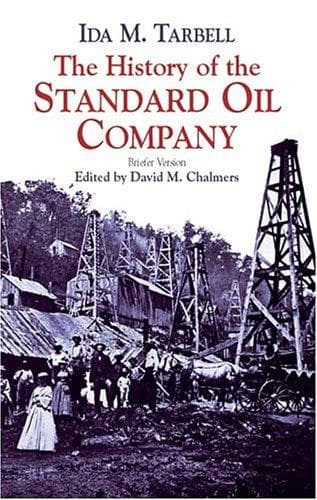
The History of the Standard Oil CompanyTarbell, Ida M. (Ida Minerva)
History
The History of the Standard Oil Company
Tarbell, Ida M. (Ida Minerva)
Petroleum industry and trade -- United States -- History; Standard Oil Company -- History
“No, sir; it is paid on all oil received and transferred by us.”
Among the interesting documents presented at this inquiry was a
statement of the crude oil shipments over the Pennsylvania road for
February and March, 1878.[77] They footed up to a total of 343,767½
barrels. On this amount a discount of twenty cents a barrel was allowed
to the Standard Oil Company through its agent, the American Transfer
Company. Among other independents who shipped this oil was H. C. Ohlen.
In all, Mr. Ohlen shipped 29,876 barrels, and on this the Standard Oil
Company received twenty cents a barrel! That is, after Mr. Ohlen had
paid for his oil, paid for having it carried by the pipe-line to the
railroad, and paid the railroad the full rate of freight without the
commission the Standard received, the Pennsylvania was obliged to turn
over to the Standard Oil Company twenty cents of the amount he had paid
on each barrel!
The examiner tried very hard to find out if there was a legitimate
reason why such an allowance should have been made to the American
Transfer Company on oil it did not handle. “We pay that,” Mr. Cassatt
said, “as a commission to them to aid in securing us our share of
trade.” “We pay it,” said the comptroller, “for procuring oil to go over
the lines in which the Pennsylvania Railroad Company is interested as
against the New York lines and the New York Central.”
“Do you understand,” the examiner questioned of one of the auditors,
“that the American Transfer Company secured to the Pennsylvania road the
traffic of the outside refiners of New York (mentioned in the statement
quoted above)?” “I never raised a question of that kind in my mind,”
answered the adroit auditor.
But the answer was evident. The American Transfer Company had nothing
whatever to do with the oil shipped by Mr. Ohlen or Ayres, Lombard and
Company or J. Rousseaux or any one of the other independents mentioned
in the statement, unless perchance that oil had come originally from the
lines of the American Transfer Company. In that case the shipper had
paid the line for the service rendered, at the time he bought the
oil—the custom then and now. The tax was paid by the Pennsylvania solely
because the Standard Oil Company had the power to demand it. The demand
was made in the name of the American Transfer Company as a blind.
Naturally the proof that the Standard had revived the most obnoxious
feature of the South Improvement Company aroused intense bitterness and
disgust among the oil men.
Public-domain text, read in full here on John Shaqi.
Reviews
Reviews
No reviews yet
Be the first to share your thoughts on this work.
Elsewhere in the archive
Join the Discussion
Join the discussion
Sign in to leave a comment or review.
Sign InorCreate an account