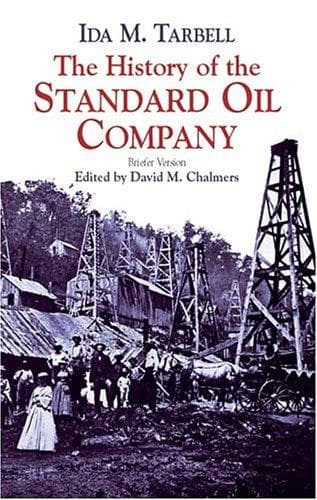
The History of the Standard Oil CompanyTarbell, Ida M. (Ida Minerva)
History
The History of the Standard Oil Company
Tarbell, Ida M. (Ida Minerva)
Petroleum industry and trade -- United States -- History; Standard Oil Company -- History
“The details of these negotiations, of course, need not, and did
not, reach the office of the executive department,” he said. “As a
part of them, however, requests were presented in the interest of
the petitioners (the Producers’ Union) to the Governor, not to issue
the requisition, followed again by requests that they be allowed to
go out. Finding that the highest process of the commonwealth was
being used simply as leverage for and against the parties to these
negotiations between contending litigants, and that, however entire
and perfect might have been the good faith in which the criminal
proceedings in Clarion County had been commenced, they were being
regarded and treated as a mere make-weight in the stages of private
diplomacy, I deemed it my duty, in the exercise of a sound
discretion, to suspend action on the requisitions.”
[Illustration:
E. G. PATTERSON
From 1872 to 1880 the chief advocate in the Oil Region of an
interstate commerce law. Assisted in drafting the bills of 1876 and
1880. Abandoned the independent interests at the time of the
compromise of 1880.
]
[Illustration:
ROGER SHERMAN
Chief counsel of the Petroleum Producers’ Union from 1878 to 1880.
From 1880 to 1885 counsel for the Standard Oil Company. From 1885 to
his death in 1893 counsel of the allied independents.
]
[Illustration:
BENJ. B. CAMPBELL
President of the Petroleum Producers’ Union from 1878 to 1880.
Independent refiner and operator until his death.
]
[Illustration:
JOSIAH LOMBARD
Prominent independent refiner of N. Y. City, whose firm was the only
one to keep its contract with the Tidewater Pipe Line Company in
1880.
]
The writer has examined all the private correspondence which passed at
this time between the litigants, but finds no proof of Governor Hoyt’s
statement that the Union at one time ceased its demands for Mr.
Rockefeller’s extradition.
The conspiracy suit had been set for the August session of the Clarion
County court. When August came the Standard sought a continuance, and it
was granted. The delay did not in any way discourage the producers, and
when Mr. Rockefeller became convinced of this he tried conciliation.
“Come, let us reason together,” has always been a favourite proposition
of Mr. Rockefeller. He would rather persuade than coerce, rather silence
than fight. He had been making peace overtures ever since the suits
began. The first had been in the fall of 1878, soon after they were
instituted, when he sent the following letter to Captain Vandergrift:
“CAPTAIN J. J. VANDERGRIFT:
Public-domain text, read in full here on John Shaqi.
Reviews
Reviews
No reviews yet
Be the first to share your thoughts on this work.
Elsewhere in the archive
Join the Discussion
Join the discussion
Sign in to leave a comment or review.
Sign InorCreate an account