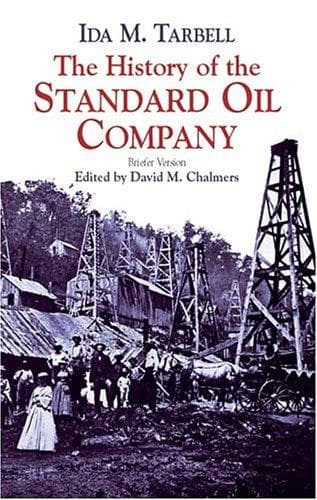
The History of the Standard Oil CompanyTarbell, Ida M. (Ida Minerva)
History
The History of the Standard Oil Company
Tarbell, Ida M. (Ida Minerva)
Petroleum industry and trade -- United States -- History; Standard Oil Company -- History
There were both humiliation and bitterness in the Council when the
report was read—humiliation and bitterness that after two years of such
strenuous fighting all that was achieved was a contract which sacrificed
what everybody knew to be the fundamental principle, the principle which
up to this point the producers had always insisted must be recognised in
any negotiation—that the rebate system was wrong and must not be
compromised with. Hard speeches were made, and Mr. Campbell’s head was
bowed more than once while big tears ran down his cheeks. He had worked
long and hard. Probably most of the members of the Grand Council who
were present had a consciousness that no one of them had done anywhere
near what Mr. Campbell had done toward prosecuting their cause, and
though they might object to the compromise, they could not blame him,
knowing all the difficulties which had been put in the way. So they
accepted the report, thanking him for his fidelity and energy, but not
failing to express their disapproval of the reservation in regard to the
rebate system. They ended their meeting by a resolution bitterly
condemning the courts, the state administration at Harrisburg, and
corporations in general:
“We declare that by the inefficiency and weakness of the secretary
of internal affairs in the year 1878; by the interposition on more
than one occasion of the attorney-general in 1879, by which the
taking of testimony was prevented; by the failure of the present
government for many months, either to grant or deny the requisition
for criminals indicted for crime, within the commonwealth of
Pennsylvania, fugitives to other states; and by the interference of
some of the judges of the Supreme Court, by an extraordinary and,
according to the best legal judgment of the land, unlawful
proceeding, by which the trial of an indictment for misdemeanour
pending in a local court was delayed and prevented, the alarming and
most dangerous influence of powerful corporations has been
demonstrated. While we accept the inevitable result forced upon us
by these influences, we aver that the contest is not over and our
objects not attained, but we all continue to advocate and maintain
the subordination of all corporations to the laws, the constitution,
and the will of the people, however and whenever expressed; that the
system of freight discrimination by common carriers is absolutely
wrong in principle, and tends to the fostering of dangerous
monopolies; and that it is the duty of the government, by
legislation and executive action, to protect the people from their
growing and dangerous power.”
And with this resolution the second Petroleum Producers’ Union formed to
fight Mr. Rockefeller came to an end.
Public-domain text, read in full here on John Shaqi.
Reviews
Reviews
No reviews yet
Be the first to share your thoughts on this work.
Elsewhere in the archive
Join the Discussion
Join the discussion
Sign in to leave a comment or review.
Sign InorCreate an account