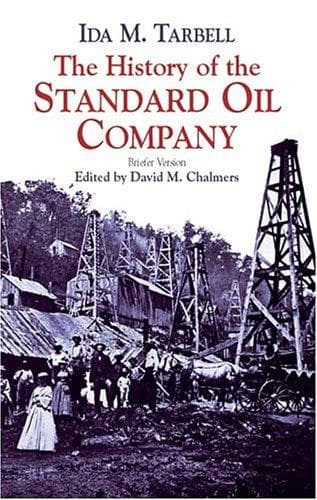
The History of the Standard Oil CompanyTarbell, Ida M. (Ida Minerva)
History
The History of the Standard Oil Company
Tarbell, Ida M. (Ida Minerva)
Petroleum industry and trade -- United States -- History; Standard Oil Company -- History
In some places wells are sunk for the purpose of accumulating the
product in a situation convenient for collection by pumping the
water out. The oil exudes on the shores of lakes and lagoons, or
rises from springs beneath the beds of rivers. Such are the springs
of Baku, in Persia, and the wells of Amiano, in the duchy of Parma,
in Italy. The usual geological position of the rocks furnishing this
natural product is in the coal measures—but it is by no means
confined to this group of rocks, since it has been found in deposits
much more recent, and also in those that are older—but in whatever
deposits it may occur, it is uniformly regarded as a product of
vegetable decomposition. Whether this decomposition has been
effected by fermentation only, or by the aid of an elevated
temperature, and distilled by heated vapour, is perhaps hardly
settled.
It is interesting, however, in this connection to remember that the
distillation, at an elevated temperature, of certain black,
bituminous shales in England and France has furnished large
quantities of an oil having many points of resemblance with naphtha,
the name given to this colourless oil, which is the usual product of
distilling petroleum. The very high boiling point of most of the
products of the distillation of the rockoil from Venango County,
Pennsylvania, would seem to indicate that it was a pyrogenic
(fire-produced) product.
Bitumen, asphaltum, mineral pitch, chapapote, etc., etc., are names
variously given to the more or less hard, black, resinous substance
which is produced usually from the exposure of petroleum to the air,
and is found either with or without the fluid naphtha or petroleum.
The most remarkable examples of the occurrence of these substances,
so intimately connected with the history of rock-oil, are the Lake
Asphaltites of the Dead Sea, so memorable in history, the well-known
Bitumen Lake of Trinidad, and the deposits of mineral pitch or
chapapote in Cuba. In one of the provinces of India, vast quantities
of petroleum are annually produced, the chief consumption being
local, for fuel and lights, but a portion is also exported to Europe
for the production of naphtha. In the United States, many points on
the Ohio and its tributaries are noted as producing this oil; nearly
all of them within the coal measures. A detailed history of these
various localities can be found recorded in books of science, and
their repetition here would be out of place.
GENERAL CHARACTER OF THE CRUDE PRODUCT
Public-domain text, read in full here on John Shaqi.
Reviews
Reviews
No reviews yet
Be the first to share your thoughts on this work.
Elsewhere in the archive
Join the Discussion
Join the discussion
Sign in to leave a comment or review.
Sign InorCreate an account