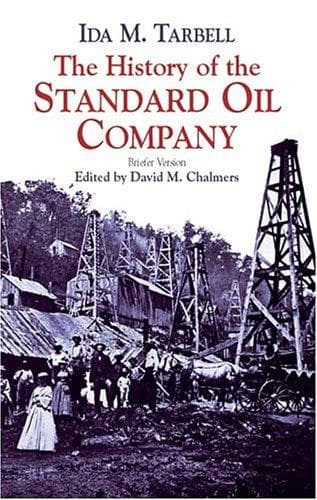
The History of the Standard Oil CompanyTarbell, Ida M. (Ida Minerva)
History
The History of the Standard Oil Company
Tarbell, Ida M. (Ida Minerva)
Petroleum industry and trade -- United States -- History; Standard Oil Company -- History
The crude oil, as it is gathered on your lands, has a dark brown
colour, which, by reflected light, is greenish or bluish. It is
thick even in warm weather—about as thick as thin molasses. In very
cold weather it is somewhat more stiff, but can always be poured
from a bottle even at 15° below zero. Its odour is strong and
peculiar, and recalls to those who are familiar with it the smell of
bitumen and naphtha. Exposed for a long time to the air, it does not
thicken or form a skin on its surface, and in no sense can it be
called a drying oil. The density of the crude oil is .882, water
being 1.000. It boils only at a very high temperature, and yet it
begins to give off a vapour at a temperature not greatly above that
of boiling water. It takes fire with some difficulty and burns with
an abundant smoky flame. It stains paper with the appearance of
ordinary fat oils, and feels smooth and greasy between the fingers.
It is frequently used in its crude state to lubricate coarse
machinery. In chemical characters, it is entirely unlike the fat
oils. Most of these characters are common to petroleum from various
places. In one important respect, however, the product of your lands
differs from that obtained in other situations, that is, it does
not, by continued exposure to the air, become hard and resinous like
mineral pitch or bitumen. I have been informed by those who have
visited the locality, that on the surface of the earth above the
springs which furnish your oil there is no crust or deposit of this
sort such as I have seen in other situations where petroleum or
mineral tar is flowing. This difference will be seen to be of
considerable importance, as it is understood and represented that
this product exists in great abundance upon your property, that it
can be gathered wherever a well is sunk in the soil, over a great
number of acres, and that it is unfailing in its yield from year to
year. The question naturally arises, Of what value is it in the
arts, and for what uses can it be employed? These researches answer
these inquiries.
EXAMINATION OF THE OIL
Public-domain text, read in full here on John Shaqi.
Reviews
Reviews
No reviews yet
Be the first to share your thoughts on this work.
Elsewhere in the archive
Join the Discussion
Join the discussion
Sign in to leave a comment or review.
Sign InorCreate an account