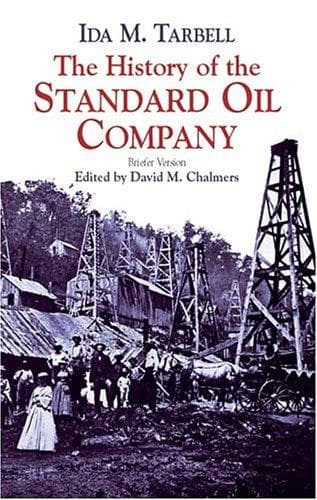
The History of the Standard Oil CompanyTarbell, Ida M. (Ida Minerva)
History
The History of the Standard Oil Company
Tarbell, Ida M. (Ida Minerva)
Petroleum industry and trade -- United States -- History; Standard Oil Company -- History
The uncertainty of the boiling points indicates that the products
obtained at the temperatures named above were still mixtures of
others, and the question forces itself upon us, whether these
several oils are to be regarded as _educts_ (i. e., bodies
previously existing, and simply separated in the process of
distillation), or whether they are not rather produced by the heat
and chemical change in the process of distillation. The continued
application of an elevated temperature alone is sufficient to effect
changes in the constitution of many organic products, evolving new
bodies not before existing in the original substance.
PROPERTIES OF THE DISTILLED OILS
Exposed to the severest cold of the past winter, all the oils
obtained in this distillation remained fluid. Only the last two or
three appeared at all stiffened by a cold of 15° below zero, while
the first three or four products of distillation retained a perfect
degree of fluidity. Exposed to air, as I have said, they suffer no
change. The chemical examination of these oils showed that they were
all composed of carbon and hydrogen, and probably have these
elements in the same numerical relation. When first distilled they
all had an acid reaction, due to the presence of a small quantity of
free sulphuric acid, derived from the crude oil. This was entirely
removed by a weak alkaline water, and even by boiling on pure water.
Clean copper remained untarnished in the oil which had thus been
prepared, showing its fitness for lubrication, so far as absence of
corrosive quality is concerned. The oils contain no oxygen, as is
clearly shown by the fact that clean potassium remains bright in
them. Strong _sulphuric acid_ decomposes and destroys the oil
entirely. _Nitric acid_ changes it to a yellow, oily fluid, similar
to the changes produced by nitric acid on other oils.
_Hydrochloric_, _chromic_, and _acetic acids_ do not affect it.
_Litharge_ and other metallic oxyds do not change it, or convert it
in any degree to a drying oil. _Potassium_ remains in it unaffected,
even at a high temperature. _Hydrates of potash_, _soda_, and _lime_
are also without action upon it. _Chloride of calcium_ and many
other salts manifest an equal indifference to it. Distilled with
_bleaching powders_ (chloride of lime) and water in the manner of
producing chloroform, the oil is changed into a product having an
odour and taste resembling chloroform. Exposed for many days in an
open vessel, at a regulated heat below 212°, the oil gradually rises
in vapour, as may be seen by its staining the paper used to cover
the vessel from dust, and also by its sensible diminution. Six or
eight fluid ounces, exposed in this manner in a metallic vessel for
six weeks or more, the heat never exceeding 200°, gradually and
slowly diminished, grew yellow, and finally left a small residue of
Public-domain text, read in full here on John Shaqi.
Reviews
Reviews
No reviews yet
Be the first to share your thoughts on this work.
Elsewhere in the archive
Join the Discussion
Join the discussion
Sign in to leave a comment or review.
Sign InorCreate an account