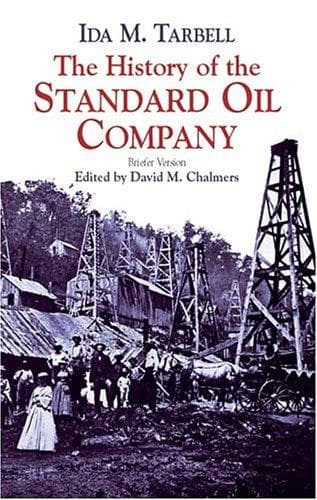
The History of the Standard Oil CompanyTarbell, Ida M. (Ida Minerva)
History
The History of the Standard Oil Company
Tarbell, Ida M. (Ida Minerva)
Petroleum industry and trade -- United States -- History; Standard Oil Company -- History
_Product No. 6._ This and the two subsequent products were each more
highly coloured and denser than the preceding. The last product had
the colour and consistency of honey, and the odour was less
penetrating than that of the preceding oils. The mass of crude
product remaining in the retort (equal 47.4 per cent.) was a dark,
thick, resinous-looking varnish, which was so stiff when cold that
it could be inverted without spilling. This showed no disposition to
harden or skin over by exposure to the air. The distillation was
arrested at this point in glass, by our having reached the limit of
temperature for a bath of linseed oil. The _density_ of the several
products of this distillation shows a progressive increase, thus:
DENSITY
No. 2 733
No. 3 752
No. 4 766
No. 5 776
No. 6 800
No. 7 848
No. 8 854
To form an idea of the comparative density of these several
products, it may be well to state that sulphuric ether, which is one
of the lightest fluids known, has a density of .736, and alcohol,
when absolutely pure, .800.
The _boiling points_ of these several fluids present some anomalies,
but are usually progressive, thus, No. 2 gave signs of boiling at
115° C. (= 239° F.), and boiled vigorously and remained constant at
225° C. to 228° C. (= 437° to 442° F.). No. 3 began to boil 120° (=
248° F.), rose to 270° (= 518° F.), where it remained constant. No.
4 began to vapourise at 140° (= 284° F.), rose to 290° (= 554° F.),
where it remained constant. On a second heating the temperature
continued to rise, and passed 305° (= 581° F.). No. 5 gave
appearance of boiling at 160° (= 320° F.), boiling more vigorously
as the heat was raised, and was still rising at 308° (= 581° F.).
No. 6 commenced boiling at 135° (= 275° F.), boiled violently at
160° (= 320° F.), and continued rising above the range of the
mercurial thermometer. No. 7 commenced ebullition at the same
temperature as No. 6, and rose to 305° (= 581° F.), where the
ebullition was not very active. Much time was consumed in obtaining
these results. We infer from them that the rock-oil is a mixture of
numerous compounds, all having essentially the same chemical
constitution, but differing in density and boiling points, and
capable of separation from each other, by a well-regulated heat.
Public-domain text, read in full here on John Shaqi.
Reviews
Reviews
No reviews yet
Be the first to share your thoughts on this work.
Elsewhere in the archive
Join the Discussion
Join the discussion
Sign in to leave a comment or review.
Sign InorCreate an account