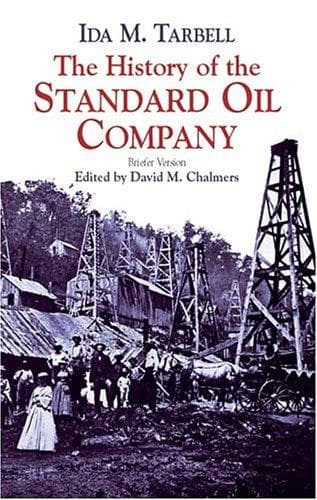
The History of the Standard Oil CompanyTarbell, Ida M. (Ida Minerva)
History
The History of the Standard Oil Company
Tarbell, Ida M. (Ida Minerva)
Petroleum industry and trade -- United States -- History; Standard Oil Company -- History
The results of the distillation at a regulated temperature in glass
led us to believe that in a metallic vessel, capable of enduring a
high degree of heat, we might obtain a much larger proportion of
valuable products. A copper still, holding five or six gallons, was
therefore provided, and furnished with an opening, through which a
thermometer could be introduced into the interior of the vessel.
Fourteen imperial quarts (or, by weight, 560 ounces) of the crude
product were placed in this vessel, and the heat raised rapidly to
about 280° C. (= 536° F.), somewhat higher than the last temperature
reached in the first distillation. At this high temperature the
distillation was somewhat rapid, and the product was easily
condensed without a worm. The product of the first stage was 130
ounces (or over 28 per cent.), of a very light-coloured thin oil,
having a density of .792. This product was also acid, and as before,
the acid was easily removed by boiling with fresh water. The
temperature was now raised to somewhat above 300° C. (= 572° F.),
and 123 ounces more distilled, of a more viscid and yellowish oil,
having a density of .865. This accounts for over 43 per cent. of the
whole quantity taken. The temperature being raised now above the
boiling point of mercury, was continued at that until 170 ounces, or
over 31 per cent., of a dark brown oil had been distilled, having a
strong empyreumatic odor. Upon standing still for some time, a dark
blackish sediment was seen to settle from this portion, and on
boiling it with water the unpleasant odour was in a great degree
removed, and the fluid became more light-coloured and perfectly
bright. (It was on a sample of this that the photometric experiments
were made.) The next portion, distilled at about 700° F., gave but
about 17 ounces, and this product was both lighter in colour and
more fluid than the last. It now became necessary to employ dry
hickory wood as a fuel, to obtain flame and sufficient heat to drive
over any further portions of the residue remaining in the alembic.
It will be seen that we have already accounted for over 75 per cent.
of the whole quantity taken. There was a loss on the whole process
of about 10 per cent. made up, in part, of a coaly residue that
remained in the alembic, and partly of the unavoidable loss
resulting from the necessity of removing the oil twice from the
alembic, during the process of distillation, in order to change the
arrangements of the thermometer, and provide means of measuring a
heat higher than that originally contemplated.
Public-domain text, read in full here on John Shaqi.
Reviews
Reviews
No reviews yet
Be the first to share your thoughts on this work.
Elsewhere in the archive
Join the Discussion
Join the discussion
Sign in to leave a comment or review.
Sign InorCreate an account