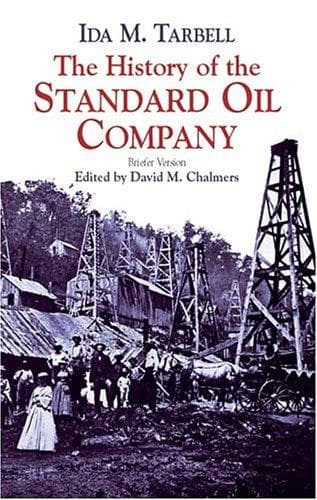
The History of the Standard Oil CompanyTarbell, Ida M. (Ida Minerva)
History
The History of the Standard Oil Company
Tarbell, Ida M. (Ida Minerva)
Petroleum industry and trade -- United States -- History; Standard Oil Company -- History
About 15 per cent. of a very thick, dark oil completed this
experiment. This last product, which came off slowly at about 750°
F., is thicker and darker than the original oil, and when cold, is
filled with a dense mass of pearly crystals. These are paraffine, a
peculiar product of the destructive distillation of many bodies in
the organic kingdom. This substance may be separated, and obtained
as a white body, resembling fine spermaceti, and from it beautiful
candles have been made. The oil in which the crystals float is of a
very dark colour, and by reflected light is blackish green, like the
original crude product. Although it distills at so high a
temperature, it boils at a point not very different from the denser
products of the first distillation. The paraffine, with which this
portion of the oil abounds, does not exist ready-formed in the
original crude product; but it is a result of the high temperature
employed in the process of distillation, by which the elements are
newly arranged.
I am not prepared to say, without further investigation, that it
would be desirable for the company to manufacture this product in a
pure state, fit for producing candles (a somewhat elaborate chemical
process); but I may add that, should it be desirable to do so, the
quantity of this substance produced may probably be very largely
increased by means which it is now unnecessary to mention.
Paraffine derives its name from the unalterable nature of the
substance, under the most powerful chemical agents. It is white, in
brilliant scales of a greasy lustre; it melts at about 116°, and
boils at over 700° F.; it dissolves in boiling alcohol and ether,
and burns in the air with a brilliant flame. Associated with
paraffine are portions of a very volatile oil, _eupione_, which
boils at a lower temperature, and by its presence renders the
boiling point of the mixture difficult to determine. I consider this
point worthy of further examination than I have been able at present
to give it, i.e., whether the last third, and possibly the last
half, of the petroleum, may not be advantageously so treated as to
produce from it the largest amount of paraffine which it is able to
produce.
The result of this graduated distillation, at a high temperature, is
that we have obtained over 90 per cent. of the whole crude product
in a series of oils, having valuable properties, although not all
equally fitted for illumination and lubrication.
A second distillation of a portion of the product which came over in
the later stages of the process (a portion distilled at about 650°
F., and having a high colour), gave us a thin oil of density about
.750, of light yellow colour and faint odour.
Public-domain text, read in full here on John Shaqi.
Reviews
Reviews
No reviews yet
Be the first to share your thoughts on this work.
Elsewhere in the archive
Join the Discussion
Join the discussion
Sign in to leave a comment or review.
Sign InorCreate an account