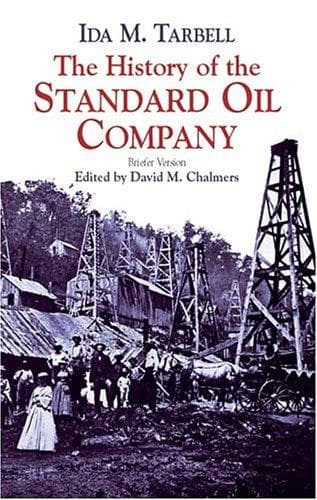
The History of the Standard Oil CompanyTarbell, Ida M. (Ida Minerva)
History
The History of the Standard Oil Company
Tarbell, Ida M. (Ida Minerva)
Petroleum industry and trade -- United States -- History; Standard Oil Company -- History
From this table it will be seen that the rock-oil lamp was somewhat
superior in illuminating power to Carcel’s lamp of the same size,
burning the most costly of all oils. It was also equal to the
“Diamond Light” from a lamp of one-half greater power, and
consequently is superior to it in the same ratio in lamps of equal
power. The camphene lamp appears to be about one-fifth superior to
it, but, on the other hand, the rock-oil surpasses the camphene by
more than one-half in economy of consumption (i.e., it does not
consume one-half so much fluid by measure), and it burns more
constantly. Compared with the sylvic oil and the sperm, the rock-oil
gave on the ground glass diaphragm the whitest disc of illumination,
while in turn the camphene was whiter than the rock-oil light. By
the use of screens of different coloured glass, all inequalities of
_colour_ were compensated in the use of the photometer, so that the
intensity of light could be more accurately compared. Compared with
gas, the rock-oil gave more light than any burner used except the
costly Argand consuming ten feet of gas per hour. To compare the
_cost_ of these several fluids with each other, we know the price of
the several articles, and this varies very much in different places.
Thus, gas in New Haven costs $4 per 1,000 feet, and in New York
$3.50 per 1,000, in Philadelphia $2.00 per 1,000, and in Boston
about the same amount.
Such sperm oil as was used costs $2.50 per gallon, the colza about
$2, the sylvic oil 50 cents, and the camphene 68 cents; no price has
been fixed upon for the rectified rock-oil.
I cannot refrain from expressing my satisfaction at the results of
these photometric experiments, since they have given the oil of your
company a much higher value as an illuminator than I had dared to
hope.
USE OF THE ROCK-OIL AS A LUBRICATOR FOR MACHINERY
A portion of the rectified oil was sent to Boston to be tested upon
a trial apparatus there, but I regret to say that the results have
not been communicated to me yet. As this oil does not gum or become
acid or rancid by exposure, it possesses in that, as well as in its
wonderful resistance to extreme cold, important qualities for a
lubricator.
CONCLUSION
In conclusion, gentlemen, it appears to me that there is much ground
for encouragement in the belief that your company have in their
possession a raw material from which, by simple and not expensive
process, they may manufacture very valuable products.
It is worthy of note that my experiments prove that nearly the
_whole_ of the raw product may be manufactured without waste, and
this solely by a well-directed process which is in practice one of
the most simple of all chemical processes.
Public-domain text, read in full here on John Shaqi.
Reviews
Reviews
No reviews yet
Be the first to share your thoughts on this work.
Elsewhere in the archive
Join the Discussion
Join the discussion
Sign in to leave a comment or review.
Sign InorCreate an account