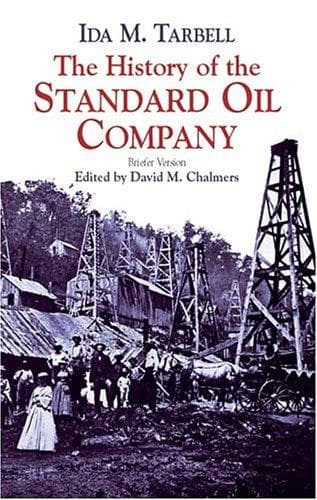
The History of the Standard Oil CompanyTarbell, Ida M. (Ida Minerva)
History
The History of the Standard Oil Company
Tarbell, Ida M. (Ida Minerva)
Petroleum industry and trade -- United States -- History; Standard Oil Company -- History
The distance between the standard candle, and the illuminator sought
to be determined, was constantly 150 inches—the photometer traversed
the graduated bar in such a manner as to read, at any point where
equality of illumination was produced, the ratio between the two
lights. I quote only single examples of the average results, and
with as little detail as possible, but I should state that the
operation of the photometer was so satisfactory that we obtained
constantly the same figures when operating in the same way, evening
after evening, and the sensitiveness of the instrument was such that
a difference of one-half inch in its position was immediately
detected in the comparative illumination of the two equal discs of
light in the dark chamber. This is, I believe, a degree of accuracy
not before obtained by a photometer.
TABLE OF ILLUMINATING POWER OF VARIOUS ARTIFICIAL LIGHTS COMPARED WITH
JUDD’S PATENT CANDLES AS A UNIT
SOURCE OF LIGHT RATIO TO
CANDLE—1
Gas burning in Scotch fish-tail tips, 4 feet to the hour 1 : 5.4
Gas burning in Scotch fish-tail tips, 6 feet to the hour 1 : 7.55
Gas burning in Cornelius fish-tail tips, 6 feet to the hour 1 : 6.3
Gas burning in English Argand burner, 10 feet to the hour 1 : 16
Rock-oil, burning in 1–inch wick camphene lamp, consuming 1¾
ounces of fluid to the hour 1 : 8.1
Carcel’s mechanical lamp, burning best sperm oil, 2 ounces of
fluid to the hour, wick ⅞ of an inch 1 : 7.5
Carcel’s mechanical lamp, burning best sperm oil, 2 ounces of
colza oil to the hour, wick of ⅞ an inch 1 : 7.5
Camphene lamp (same size as rock-oil above) burning best
camphene, 4 fluid ounces per hour 1 : 11
“Diamond Light” by “sylvic oil,” in 1½–inch wick, 4 ounces
per hour 1 : 8.1
Public-domain text, read in full here on John Shaqi.
Reviews
Reviews
No reviews yet
Be the first to share your thoughts on this work.
Elsewhere in the archive
Join the Discussion
Join the discussion
Sign in to leave a comment or review.
Sign InorCreate an account