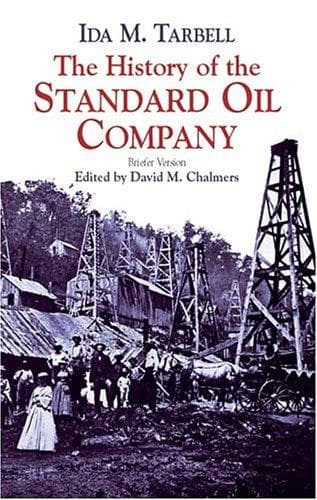
The History of the Standard Oil CompanyTarbell, Ida M. (Ida Minerva)
History
The History of the Standard Oil Company
Tarbell, Ida M. (Ida Minerva)
Petroleum industry and trade -- United States -- History; Standard Oil Company -- History
J. H. Devereux, being first duly sworn, says that he is forty-eight
years of age, and is president of the New York, Pennsylvania and
Ohio Railroad; that in 1868 he became vice-president of the Lake
Shore Railroad, and remained in that position as well as president
and general manager till 1873. That he has heard read the statements
of Robert Hanna and George O. Baslington, in their affidavits filed
herein in respect to transportation of oil, and in regard thereto he
has to say that his experience with the oil traffic began in 1868
when he went upon the Lake Shore Railroad as vice-president,
succeeding Mr. Stone who retired from ill health; that the only
written memoranda connected with the business of the company with
which he was furnished was a book in which it was stated—probably in
Mr. Stone’s handwriting—that the representatives of the various oil
interests of Cleveland would agree to pay a rate of 1 cent. per
gallon on crude oil moved from the regions to Cleveland; that in
addition to the inevitable friction arising from the competition of
these refiners of Cleveland—probably aggregating twenty-five in
number, was the further difficulty of the patent right which the
Pennsylvania Railroad claimed to the transportation of oil, and the
peculiar differences made by them in the rates given to refiners at
Titusville, Pittsburg, and other places all thoroughly in
competition with the then very limited refining capacity of
Cleveland; that he took up the subject as to whether the Lake Shore
Railroad could hope to compete for the transportation of oil, and
the end of the matter was that the Jamestown and Franklin Railroad
was extended from Franklin to Oil City, the then centre of the
producing district, and a sharper contest than ever was produced,
growing out of the opposition of the Pennsylvania Railroad in
competition; that such rates and arrangements were made by the
Pennsylvania Railroad, that it was publicly proclaimed in the public
print in Oil City, Titusville, and other places that Cleveland was
to be wiped out as a refining centre as with a sponge, and without
exception the oil refiners of Cleveland came to affiant as a
representative of transportation, and with a single exception
expressed their fears that they would have either to abandon their
business here or move to Titusville or other points in the Oil
Regions; that the only exception to this decision was that offered
by Rockefeller, Andrews and Flagler, who on its assurance that the
Lake Shore Railroad could and would handle oil as cheaply as the
Pennsylvania Company, proposed to stand their ground at Cleveland
and fight it out on that line. That later, about 1870, the first
move was made to transport refined oil by rail regularly and
throughout the entire year from Cleveland to New York. That prior to
that time the export business from Cleveland was comparatively
Public-domain text, read in full here on John Shaqi.
Reviews
Reviews
No reviews yet
Be the first to share your thoughts on this work.
Elsewhere in the archive
Join the Discussion
Join the discussion
Sign in to leave a comment or review.
Sign InorCreate an account