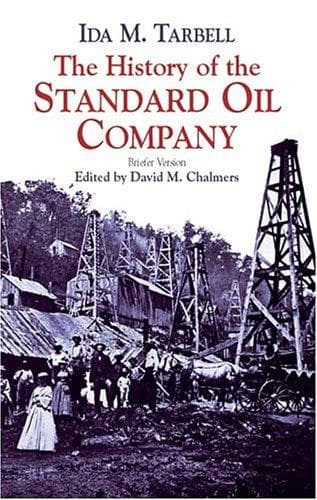
The History of the Standard Oil CompanyTarbell, Ida M. (Ida Minerva)
History
The History of the Standard Oil Company
Tarbell, Ida M. (Ida Minerva)
Petroleum industry and trade -- United States -- History; Standard Oil Company -- History
limited and was confined to the summer months, most of that portion
of the traffic refined at Cleveland in competition with Pittsburg,
Titusville, and other places being shipped by lake and canal, and as
affiant remembers at a rate of about one dollar per barrel, and with
a certainty of its being reduced to ninety cents. That the rail rate
was nominally two dollars on refined oil from Cleveland to New York.
That Mr. Flagler, at this time representing Rockefeller, Andrews and
Flagler, proposed to make regular monthly shipments by rail
throughout the year provided a proper rate could be made for the
business then offered, this rate to cover transportation of crude
from the region to Cleveland, and when refined from Cleveland to New
York. Rockefeller, Andrews and Flagler being the only refiners here
who proposed to compete for the export business or offered oil for
the entire haul from the regions to Cleveland and thence to New
York; that Mr. Flagler’s proposition was to assure to the Lake Shore
Railroad sixty carloads of refined oil per day[83] from Cleveland to
New York at a rate of $1.75 per barrel from the regions to New York,
being thirty-five cents per barrel for crude from the regions to
Cleveland and $1.30 per barrel for refined from Cleveland to New
York; and Rockefeller, Andrews and Flagler were to assume all risk
and losses from fire or other accidents. That affiant took this
proposition into consideration and made careful computation of the
cost of this transportation to the railroad, which cost is the
proper basis in fixing the rate to be charged; that affiant found
that the then average time for a round trip from Cleveland to New
York for a freight car was thirty days; to carry sixty cars per day
would require 1,800 cars at an average cost of $500 each, making an
investment of $900,000 necessary to do this business, as the
ordinary freight business had to be done; but affiant found that if
sixty carloads could be assured with absolute regularity each and
every day, the time for a round trip from Cleveland to New York and
return could be reduced to ten days, by moving these cars in solid
trains instead of mixing oil cars in other trains, as would be
necessary when transported in small quantities and by moving the oil
trains steadily without regard to other cars; that by thus reducing
the time to ten days for a round trip, only six hundred cars would
be necessary to do this business with an investment therefore of
only $300,000. That the regularity of the traffic would insure
promptness in the unloading and return of the cars; that upon these
considerations affiant concluded that Mr. Flagler’s proposition
offered to the railroad company a larger measure of profit than
would or could ensue from any business to be carried under the old
arrangements, and such proved to be pre-eminently the case; that the
proposition of Mr.
Public-domain text, read in full here on John Shaqi.
Reviews
Reviews
No reviews yet
Be the first to share your thoughts on this work.
Elsewhere in the archive
Join the Discussion
Join the discussion
Sign in to leave a comment or review.
Sign InorCreate an account