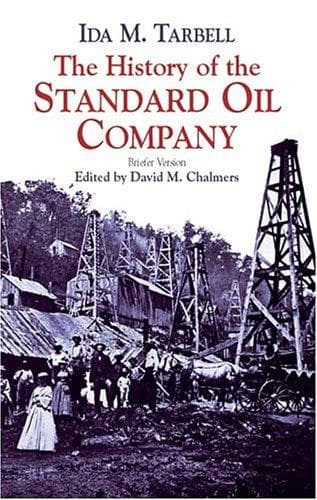
The History of the Standard Oil CompanyTarbell, Ida M. (Ida Minerva)
History
The History of the Standard Oil Company
Tarbell, Ida M. (Ida Minerva)
Petroleum industry and trade -- United States -- History; Standard Oil Company -- History
Flagler was therefore accepted, and in affiant’s
judgment this was the turning-point which secured to Cleveland a
considerable portion of the export traffic. That this arrangement
was at all times open to any and all parties who would secure or
guarantee a like amount of traffic or an amount sufficient to be
treated and handled in the same speedy and economical way, the
charges for transportation being always necessarily based upon the
actual cost of the service to the railroad, and whenever any shipper
or shippers will unite to reduce the cost of transportation to the
railroad, to refuse to give them the benefit of such reduction would
be to the detriment of the public, the consumers, who in the end pay
the transportation charges. Affiant says that this legitimate and
necessary advantage of the large shipper over the smaller he
explained to Mr. Hanna and Mr. Baslington, and they recognised its
propriety, and affiant offered them the same terms if by themselves
or with others they would assure him like quantities with like
regularity, thus securing like speed and economy in transportation.
And further affiant saith not.
J. H. DEVEREUX.
Subscribed in my presence and sworn to before me this thirteenth day
of November, 1880.
J. C. CANNON,
_Notary Public in and for Said County_.
NUMBER 4 (See page 1055)
TESTIMONY OF HENRY M. FLAGLER ON THE SOUTH IMPROVEMENT COMPANY
[Proceedings in Relation to Trusts, House of Representatives, 1888.
Report Number 3112, pages 289–290.]
_A._ ... Neither of the Messrs. Rockefeller, Colonel Payne, nor
myself, nor any one connected with the Standard Oil Company, ever
had any confidence in or regard for the scheme known as the South
Improvement Company. We did not believe in it, but the view
presented by other gentlemen was pressed upon us to such an extent
that we acquiesced in it to the extent of subscribing our names to a
certain amount of the stock, which was never paid for. The company
never did a dollar’s worth of business, and never had any existence
other than its corporative existence, which it obtained through its
charter. Through its president it negotiated certain railroad
contracts, which, as I remember now, were signed by the company and
by the officers of the railroad. Those contracts were held in escrow
a few weeks and were destroyed or cancelled by mutual consent.
_Q._ Who presented these views to you gentlemen? Who was the person
that had charge of this South Improvement Company’s scheme?
_A._ I think Mr. Warden and the Messrs. Logan were the great leaders
in the South Improvement Company policy.
Public-domain text, read in full here on John Shaqi.
Reviews
Reviews
No reviews yet
Be the first to share your thoughts on this work.
Elsewhere in the archive
Join the Discussion
Join the discussion
Sign in to leave a comment or review.
Sign InorCreate an account