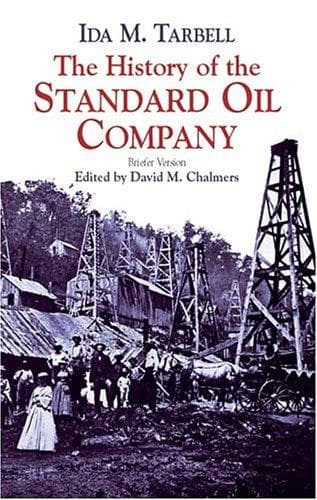
The History of the Standard Oil CompanyTarbell, Ida M. (Ida Minerva)
History
The History of the Standard Oil Company
Tarbell, Ida M. (Ida Minerva)
Petroleum industry and trade -- United States -- History; Standard Oil Company -- History
_A._ Yes, sir, the South Improvement Company had to enter into a
contract, such substantially as I have furnished a draft of here, to
give the producers the full benefit of everything connected with the
contract before the contract itself could go into effect.
_Q._ There are three principal interests connected with the oil
trade?
_A._ There are, the producers, refiners and transporters; no
injustice could be done to either interest without affecting,
injuriously, the others. The object of the railroads in this matter
was to promote the interests of the trade in order to promote their
own interests.
By the Chairman.
_Q._ You say there were three interests, producers, refiners and
shippers?
_A._ Yes, sir, connected with the trade.
_Q._ And that the object of all these arrangements was to protect
these three interests?
_A._ To protect these three interests and incidentally, of course,
protecting the general interest in doing that, for this is
peculiarly an American traffic.
_Q._ It was in the direction of increasing to each of these parties,
respectively the benefits and profits of the business?
_A._ Yes, sir, that each might receive a fair profit. The railroad
companies had not been receiving cost for transportation, and it was
to save them from loss, for they had been transporting at a loss
during the whole of the year 1871.
_Q._ Well, that is to increase profits, is it not?
_A._ Yes, to save from loss.
_Q._ Did it look to increasing in any way the benefits of cheapness
to the consumer?
_A._ Yes, sir.
_Q._ How?
_A._ By steadying the trade. You will notice what all those familiar
with this trade know, that there are very rapid and excessive
fluctuations in the oil market; that when these fluctuations take
place the retail dealers are always quick to note a rise in price,
but very slow to note a fall. Even if two dollars a barrel had been
added to the price of oil, under a steady trade, I think the price
of the retail purchaser would not have been increased. That
increased price would only amount to one cent a quart, and I think
the price would not have been increased to the retail dealer because
the fluctuation would have been avoided. That was one object to be
accomplished. Moreover, there is only one-sixth of the oil produced
here consumed in this country—a very small proportion of the
product. In discussing what compensating advantage would arise from
an increase of price, the railroad companies considered, in the
first place, that there was a very great compensation afforded by a
steady trade.
_Q._ Will you state to the committee how, with your mode of arriving
at these conclusions, that cheapness to the consumer is promoted by
stability in trade—how that arrangement which gave $1.50 a barrel to
the South Improvement Company benefited either the railroad company
or the producer?
Public-domain text, read in full here on John Shaqi.
Reviews
Reviews
No reviews yet
Be the first to share your thoughts on this work.
Elsewhere in the archive
Join the Discussion
Join the discussion
Sign in to leave a comment or review.
Sign InorCreate an account