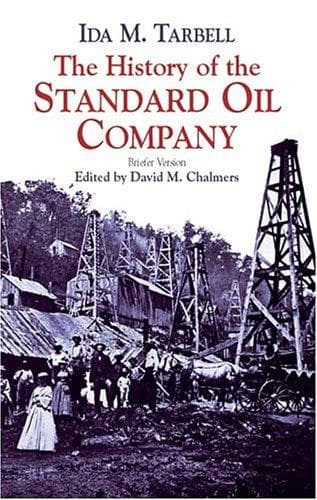
The History of the Standard Oil CompanyTarbell, Ida M. (Ida Minerva)
History
The History of the Standard Oil Company
Tarbell, Ida M. (Ida Minerva)
Petroleum industry and trade -- United States -- History; Standard Oil Company -- History
_A._ The condition is not embodied upon the face of the contract; it
is a condition upon which I held the contracts.
_Q._ Now Mr. Watson, as a lawyer, if you are such, are verbal
conditions made with a third party to change the terms of a written
contract executed in all respects?
_A._ Let me give you an illustration within my experience that is
exactly parallel to this: I had a note executed, sealed, and
complete in every way, put into my possession to be delivered upon
the production of a deed.
_The Chairman._—Wait a moment, there must be some kind of order in
this proceeding. I wish you to answer the question which has been
asked you, whether as a lawyer the conditions stated would change
the terms of a written contract. If you are able to give an answer
to that legal question you may do so.
_Witness._—Let me hear the question and I will endeavour to answer
it fully, if you will allow me to answer it in my own way.
By Mr. Sheldon.
_Q._ The question is, whether a verbal understanding to be performed
by other parties not embraced in the written contract can be made
effective to modify the terms of that contract as between the
parties to it.
_A._ An agreement between the parties to a contract, whether verbal
or written, fixing the terms upon which the contract shall go into
effect, is perfectly competent and would be binding.
_Q._ That is your opinion as a lawyer?
_A._ That is my opinion.
_Q._ Now, sir, these contracts contemplated a considerable increase
in the freight charges, both upon crude and refined petroleum?
_A._ They contemplate an increase almost up to the price for coal
and lumber, as they are ordinarily carried, amounting to about 1½
cents a pound.
_Q._ Did it contemplate an increase upon both crude petroleum and
refined oil?
_A._ Certainly; the railroads had been carrying these articles at a
loss of nearly a million dollars; they carried for less than cost,
and one object of these contracts was to increase the price of
freight to the railroads.
_The Chairman._—Let me suggest the propriety of first answering the
question and then giving your explanation. That is the regular
course, and I am sorry to say that during your whole examination
there has not been a direct answer given to a question.
_Witness._—Well, sir, where a question is such that it would give a
false impression unless answered fully and fairly, I do not want to
convey that false impression by my testimony.
Mr. Sheldon.
_Q._ Very well, I am satisfied with your explanation; now could not
these railroad companies have raised the price of freight without
the intervention of the South Improvement Company?
_A._ There were a good many difficulties in the way.
_Q._ Could they not have done it, and had they not the power to do
it?
Public-domain text, read in full here on John Shaqi.
Reviews
Reviews
No reviews yet
Be the first to share your thoughts on this work.
Elsewhere in the archive
Join the Discussion
Join the discussion
Sign in to leave a comment or review.
Sign InorCreate an account