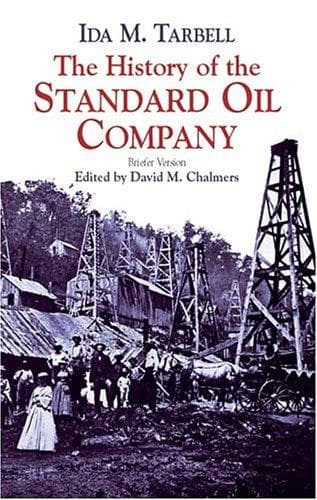
The History of the Standard Oil CompanyTarbell, Ida M. (Ida Minerva)
History
The History of the Standard Oil Company
Tarbell, Ida M. (Ida Minerva)
Petroleum industry and trade -- United States -- History; Standard Oil Company -- History
_Q._ Do you not see then that you had the producers of the Oil
Regions absolutely in your control?
_A._ No, sir.
_Mr. Sheldon._—I do.
_Witness._—I do not, and will tell you why; you asked me a question
that is a good deal like attempting to make the Bible prove that it
says itself “that there is no God.”
_The Chairman._—All our time is being expended in this way. Will you
answer the direct question put to you?
_Witness._—I want to answer it truly. It is an essential part of
this contract that the producers should be joined in it; therefore
it was not hostile to the producers in any of its intents or
purposes; it never would have gone into effect unless the producers
had joined.
By Mr. Sheldon.
_Q._ That may be the fact, but if the producers had refused to join,
could you not have forced them into the arrangement on your own
terms?
_A._ No, sir; because the South Improvement Company had no contract.
_Q._ You have a contract?
_A._ No, sir; it has no contract.
_Q._ Did it never have?
_A._ No, sir; they are placed in escrow with me. It has never had
any, that is, there is not to-day and has not at any time been a
contract in existence, in activity, or in force between the
railroads and the South Improvement Company.
By Mr. Hambleton.
_Q._ Is not that entirely due to the excitement produced in
consequence of the contracts having been entered into?
_A._ If the purchasers had entered into the contract which was
contemplated by the South Improvement Company, it would have been
entirely satisfactory to all parties, and both contracts would have
gone into operation.
_Q._ And if a party of the producers had joined, you could have
forced the balance to have gone into the arrangement?
_A._ Two-thirds were required.
_Q._ You could have forced the balance to have gone in?
_A._ The majority rules in most kinds of business; unless two-thirds
had joined, no arrangement would have been made.
_Q._ Let us see whether you have not power to force the producers;
by your contract with the railroads you had the advantage of forty
cents a barrel to Cleveland and Pittsburg, and $1.06 to New York,
Philadelphia, Baltimore or Boston on crude petroleum; while on
refined petroleum you had the advantage to these cities of fifty
cents a barrel, and from any other point to New York, Philadelphia,
Baltimore and Boston of thirty-two cents a barrel; it seems to me at
that advantage you could have compelled the producers to do exactly
what you wanted them to do?
_A._ The South Improvement Company never could have had that
advantage, because the condition on which the main contract with the
railroads was to be enforced was that the producers should join with
them and participate in the benefits.
_Q._ Is that embodied in the different contracts?
Public-domain text, read in full here on John Shaqi.
Reviews
Reviews
No reviews yet
Be the first to share your thoughts on this work.
Elsewhere in the archive
Join the Discussion
Join the discussion
Sign in to leave a comment or review.
Sign InorCreate an account