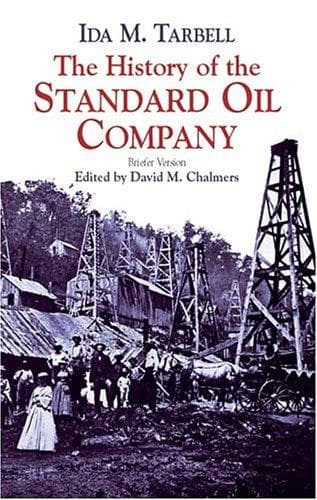
The History of the Standard Oil CompanyTarbell, Ida M. (Ida Minerva)
History
The History of the Standard Oil Company
Tarbell, Ida M. (Ida Minerva)
Petroleum industry and trade -- United States -- History; Standard Oil Company -- History
Although Mr. Rockefeller was everywhere, and heard everything in these
days, he rarely talked. “I remember well how little he said,” one of the
most aggressively independent of the Titusville refiners told the
writer. “One day several of us met at the office of one of the refiners,
who, I felt pretty sure, was being persuaded to go into the scheme which
they were talking up. Everybody talked except Mr. Rockefeller. He sat in
a rocking-chair, softly swinging back and forth, his hands over his
face. I got pretty excited when I saw how those South Improvement men
were pulling the wool over our men’s eyes, and making them believe we
were all going to the dogs if there wasn’t an immediate combination to
put up the price of refined and prevent new people coming into the
business, and I made a speech which, I guess, was pretty warlike. Well,
right in the middle of it John Rockefeller stopped rocking and took down
his hands and looked at me. You never saw such eyes. He took me all in,
saw just how much fight he could expect from me, and I knew it, and then
up went his hands and back and forth went his chair.”
For fully a week this quiet circulation among the oil men went on, and
then, on May 15 and 16, public meetings were held in Titusville, at
which the new scheme which they had been advocating was presented
publicly. This new plan, called the “Pittsburg Plan”[27] from the place
of its birth, had been worked out by the visiting gentlemen before they
came to the Oil Regions. It was a most intelligent and comprehensive
proposition.
As in the case of the South Improvement scheme, a company was to be
formed to run the refining business of the whole country, but this
company was to be an open instead of a secret organisation, and all
refiners were to be allowed to become stockholders in it. The owners of
the refineries who went into the combination were then to run them in
certain particulars according to the direction of the board of the
parent company; that is, they were to refine only such an amount of oil
as the board allowed, and they were to keep up the price for their
output as the board indicated. The buying of crude oil and the
arrangements for transportation were also to remain with the directors.
Each stockholder was to receive dividends whether his plant operated or
not. The “Pittsburg Plan” was presented tentatively. If anything better
could be suggested they would gladly accept it, its advocates said. “All
we want is a practical combination. We are wed to no particular form.”
Public-domain text, read in full here on John Shaqi.
Reviews
Reviews
No reviews yet
Be the first to share your thoughts on this work.
Elsewhere in the archive
Join the Discussion
Join the discussion
Sign in to leave a comment or review.
Sign InorCreate an account