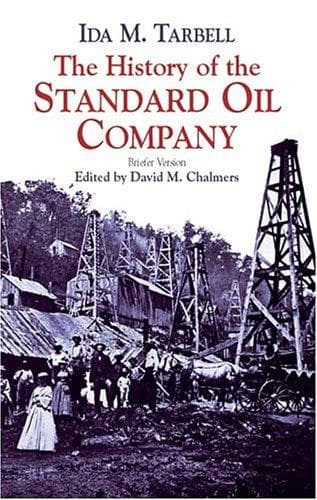
The History of the Standard Oil CompanyTarbell, Ida M. (Ida Minerva)
History
The History of the Standard Oil Company
Tarbell, Ida M. (Ida Minerva)
Petroleum industry and trade -- United States -- History; Standard Oil Company -- History
Captain Hasson and those who were working with him would have had a much
more difficult task in arousing the producers to action if it had not
been for the general dissatisfaction over the price of oil. The average
price of crude in the month of August, 1872, was $3.47½. The year before
it had been $4.42½, and that was considered a poverty price. It was
pretty certain that prices would fall still lower, that “three-dollar
oil” was near at hand. Everybody declared three dollars was not a
“living price” for oil, that it cost more than that to produce it. The
average yield of the wells in the Oil Region in 1872 was five barrels a
day. Now a well cost at that time from $2,500 to $8,000, exclusive of
the price of the lease. It cost eight to ten dollars a day to pump a
well, exclusive of the royalty interest—that is, the proportion of the
production turned over to the land-owner, usually one-fourth.[28] If a
man had big wells, and many of them, he made big profits on
“three-dollar oil,” but there were comparatively few “big producers.”
The majority of those in the business had but few wells, and these
yielded only small amounts.
If he had been contented to economise and to accept small gains, even
the small producer could live on a much lower price than three dollars;
but nobody in the Oil Regions in 1872 looked with favour on economy, and
everybody despised small things. The oil men as a class had been brought
up to enormous profits, and held an entirely false standard of values.
As the Derrick told them once in a sensible editorial, “their business
was born in a balloon going up, and spent all its early years in the
sky.” They had seen nothing but the extreme of fortune. One hundred per
cent. per annum on an investment was in their judgment only a fair
profit. If their oil property had not paid for itself entirely in six
months, and begun to yield a good percentage, they were inclined to
think it a failure. Now nothing but five-dollar oil would do this, so
great were the risks in business; and so it was for five-dollar oil,
regardless of the laws of supply and demand, that they struggled. They
were notoriously extravagant in the management of their business. Rarely
did an oil man write a letter if he could help it. He used the telegraph
instead. Whole sets of drilling tools were sometimes sent by express. It
was no uncommon thing to see near a derrick broken tools which could
easily have been mended, but which the owner had replaced by new ones.
It was anything to save bother with him. Frequently wells were abandoned
which might have been pumped on a small but sure profit. In those days
there were men who looked on a ten-barrel (net) well as hardly worth
taking care of. And yet even at fifty cents a barrel such a well would
have paid the owner $1,800 a year. The simple fact was that the profits
which men in trades all over the country were glad enough to get, the
oil producer despised. The one great thing which the Oil Regions did not
Public-domain text, read in full here on John Shaqi.
Reviews
Reviews
No reviews yet
Be the first to share your thoughts on this work.
Elsewhere in the archive
Join the Discussion
Join the discussion
Sign in to leave a comment or review.
Sign InorCreate an account